

JR DBA can help evaluate the 50% flood threshold, architectural barrier removal, and potential seismic-upgrade triggers.
“Substantial improvement” has a specific meaning in floodplain regulation. Understanding that meaning is only the first step in determining what your remodel must address.
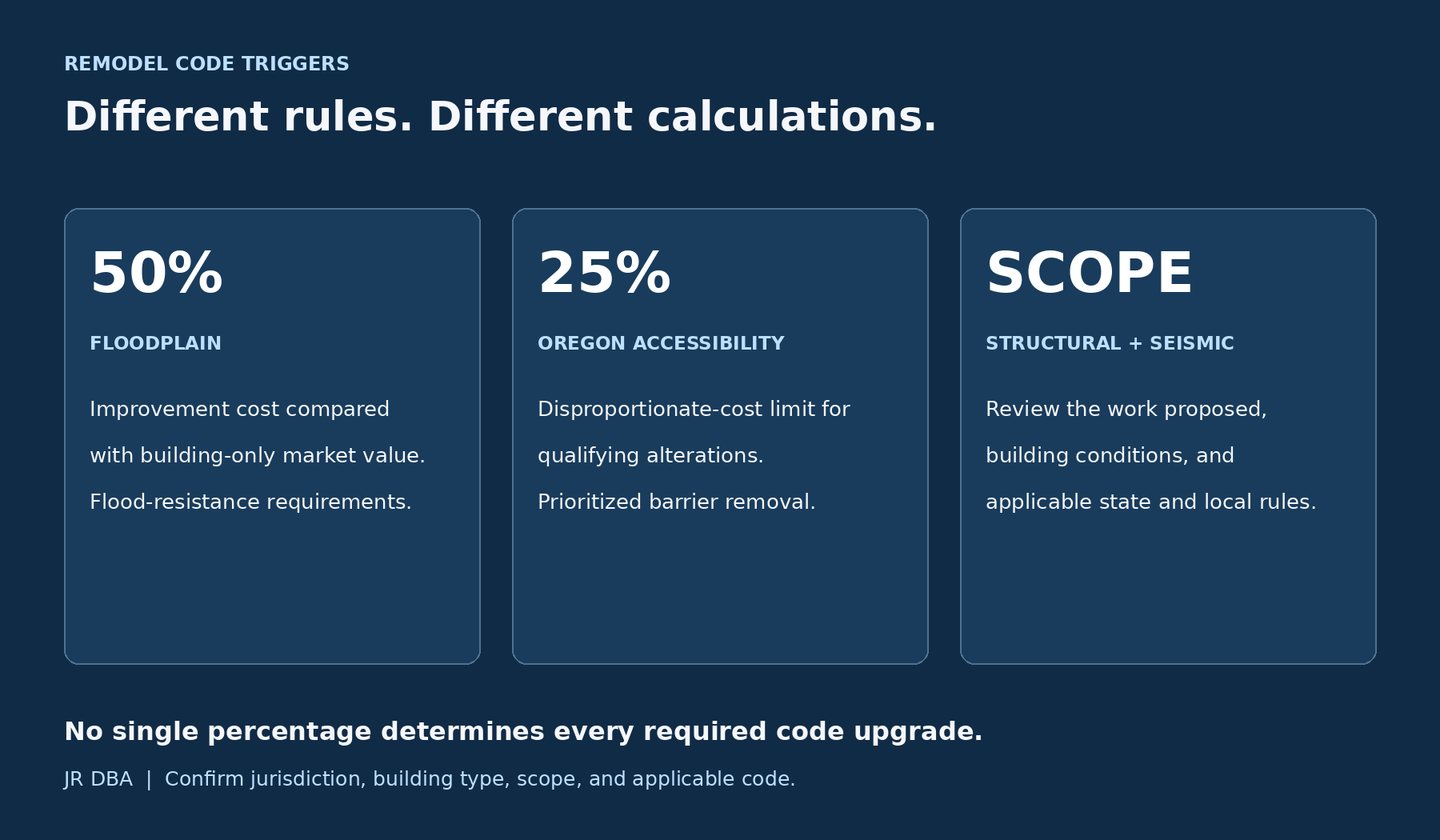
Owners often hear that a renovation exceeding 50% of a building’s value requires a complete code upgrade. Oregon does not have one universal rule that works that way. The requirements depend on the building, its location, and the work proposed.
A floodplain project may trigger substantial-improvement requirements. Work in an affected Oregon building must also be evaluated for architectural barrier removal under ORS 447.241. In Portland, Chapter 24.85 governs local seismic-upgrade requirements for existing buildings. These reviews should inform the scope before the construction budget is finalized.
What the 50% Substantial Improvement Threshold Means
Under Portland City Code 24.50.030, substantial improvement generally includes repairs, reconstruction, and improvements costing at least 50% of the structure’s market value before work begins.
The denominator is the value of the structure, excluding land. The total property purchase price is not the correct comparison when it includes land value. Confirm the jurisdiction’s accepted valuation method.
Which Costs Count Toward 50%?
The calculation generally considers the value of the improvement work, including labor, materials, and applicable contractor overhead and profit. Donated materials, discounted materials, and owner-performed labor must be assigned appropriate values; a smaller cash payment does not necessarily mean a lower regulatory project cost.
Some expenses may be excluded under the applicable guidance. Have the estimate reviewed against the jurisdiction’s requirements rather than assuming every invoice is included or that unpaid work can be omitted. FEMA’s substantial-improvement guidance explains the calculation framework.
JR DBA can help define the proposed scope, identify which work and costs count toward the 50% threshold, and organize the documentation for review. This includes identifying questions that require confirmation from the local floodplain administrator, who makes the regulatory determination.
What Crossing the Threshold Can Require
Under Portland’s flood hazard reduction provisions, a substantially improved residential structure must have its lowest floor, including a basement, at or above the applicable flood protection elevation. If it is below that elevation, substantial changes may be necessary. Floodproofing does not substitute for elevating that residential lowest-floor space.
Qualifying nonresidential buildings may use certified floodproofing as an alternative to elevation. Other applicable requirements address anchorage, flood-resistant materials, and protection of utilities and equipment.
These requirements can affect the existing building beyond the remodeled rooms. They do not automatically require every building system to satisfy every current code provision.
Staying below 50% does not eliminate floodplain regulation. Floodplain permits, floodway restrictions, and other applicable development requirements may still apply. Confirm both FEMA mapping and locally regulated flood hazard areas.
Damage and Exceptions Need Careful Review
Substantial damage occurs when the cost of fully restoring the structure to its pre-damage condition equals or exceeds 50% of its pre-damage market value. Choosing partial repairs does not remove an existing substantial-damage determination. The damage can result from fire or another cause, not only flooding.
The federal health-and-safety exception is limited to correcting existing violations identified by the local code-enforcement official, using the minimum work necessary for safe living conditions. Ordinary modernization does not automatically qualify.
Historic structures may qualify for an exception, but eligibility depends on the designation and proposed work. Federal rules require the alterations to preserve the structure’s continued historic designation and recognize certain contributing structures in historic districts. Portland’s ordinance also identifies listed historic structures. Confirm eligibility with the floodplain administrator before relying on an exception.
Reference: 44 CFR 59.1 — substantial improvement, substantial damage, and historic structures.
Outside the Flood Rule, Start With the Actual Work
Oregon’s alteration provisions generally distinguish the proposed work from portions of a building left unchanged, subject to specific exceptions. For residential projects, 2026 ORSC R102.6.1 generally requires additions and alterations to meet the applicable new-construction requirements without automatically upgrading the entire existing structure. The work cannot make the existing building less compliant or create unsafe conditions.
First establish whether the Oregon Residential Specialty Code or Oregon Structural Specialty Code governs the project. Removing a bearing wall, adding floor area, and changing occupancy can have different consequences from replacing finishes, even when the budgets are similar.
Oregon’s 25% Accessibility Rule Answers a Different Question
For an affected building, alterations to a primary function area can trigger additional accessibility work. Under ORS 447.241, costs above 25% of the qualifying primary-function alteration may be disproportionate.
Budget for required improvements up to that limit, following statutory priorities. Oregon’s Statewide Code Interpretation 14-01 explains that, after the path of travel complies, other accessible elements may still require improvement until the allocation is exhausted or the building complies.
This is not an automatic 25% surcharge when no further barrier removal is required. Nor does the cap excuse accessibility compliance in the new work itself. Related primary-function alterations on the same path of travel within the preceding three years are considered together.
This provision generally matters for commercial and public facilities, rather than an ordinary single-family remodel or ADU. The state interpretation excludes covered multifamily dwellings from this particular provision; separate accessibility requirements may still apply.
Seismic Triggers Require Their Own Review
Oregon’s structural alteration requirements and local seismic ordinances also need consideration. It is too broad to say seismic upgrades are entirely a local matter.
Portland City Code 24.85 addresses changes of occupancy, additions, structural alterations, and damage repair. Depending on the trigger, requirements may extend to the entire building.
Unreinforced masonry buildings also have specific roof-work and alteration-cost triggers. The ordinance’s base dollar figures are adjusted annually, so confirm current thresholds rather than relying on an old dollar-per-square-foot number.
For more context, see Understanding Portland City Code 24.85.
What to Confirm Before Finalizing the Remodel
- Location: Does a regulated flood hazard area affect the structure?
- Valuation: Which building value and improvement costs will the jurisdiction accept?
- Existing conditions: What is the documented legal use, construction type, and permit history?
- Work proposed: Are you changing structure, floor area, exits, or occupancy?
- Accessibility: Does the work affect a primary function area in an affected building?
- Seismic review: Do state provisions or a local ordinance trigger improvements?
Frequently Asked Questions
Does an expensive remodel always require a full code upgrade?
No. Cost alone does not answer the question. The applicable code, project scope, site conditions, and specific triggers determine the required improvements.
Can work below 50% still require upgrades?
Yes. Staying below a flood substantial-improvement threshold does not remove other alteration, accessibility, structural, or local seismic requirements.
Can I split the work into smaller permits?
Do not assume separate permits reset a threshold. Some requirements consider work over a defined period. Have the full planned scope evaluated before choosing a permit strategy.
Understand the Requirements Before Committing to the Scope
If you’re planning a residential remodel, commercial renovation, or property conversion in the Portland area, JR DBA can help identify the code and permit requirements that should inform your early decisions.
A focused review can clarify which questions need building-department confirmation and where specialist engineering or additional documentation may be needed.
Contact Joshua at Joshua@jr-dba.com or 971.217.7967 for a free initial consultation.
Author Note
Joshua Richards, AIA
Principal | JR Design Build Architect (JR DBA)
Washington Licensed Architect
ICC Certified Commercial & Residential Building Inspector + Plans Examiner
Residential Design | Building Code & Permit Support | Owner’s Representation
www.jr-dba.com | Joshua@jr-dba.com | 971.217.7967
Serving Oregon and Southwest Washington, including Portland, Beaverton, Hillsboro, Tigard, Lake Oswego, Washington County, Vancouver, Camas, and Battle Ground. Services are provided within applicable licensing requirements; projects outside these areas are considered case by case.
Related Reading
- Portland’s Seismic Upgrade Requirements
- Commercial Tenant Improvements in Vancouver, WA
- What to Check Before Buying Commercial Property in Portland
Code references reviewed October 23, 2026. Requirements depend on the applicable code edition, jurisdiction, building, and proposed work.
