
My Oregon Building Permit Was Rejected or Stalled—What Should I Do Next?

A stalled Oregon building permit doesn't always mean the same thing — corrections required, expired, or denied all call for a different response.
A practical guide to diagnosing why a permit stopped moving and choosing the right path to get it moving again
Open a permit portal after a review cycle and you may find some version of the same message: Corrections required. Application incomplete. Additional information needed. Denied. Expired.
To an owner, every one of those can feel like a rejected permit. They are not the same condition, and they do not call for the same response.
“Rejected” is not one diagnosis. It can describe at least five different permit problems.
The first task is not to argue with the reviewer or redraw the entire project. It is to identify precisely where the permit stopped, why it stopped, and what decision is needed to move it again.
Building Code and Permit Support · Permit Recovery
JR-DBA provides architect-led building-code and permit support for stalled, rejected, expired, and code-disputed residential and light commercial permits throughout Oregon. We review the permit history, identify the underlying issue, and prepare a coordinated response intended to reduce avoidable correction cycles.
First, Identify What “Rejected” Actually Means
Owners frequently use rejected to describe any permit that has not been approved. Building departments use more specific statuses. Before changing anything, confirm which of the following conditions is controlling your permit.
1. The Application Was Returned Before Technical Review
An application can be stopped during intake because required information is missing, the wrong application was used, initial fees have not been paid, or land-use approval has not been established. This is usually a completeness problem, not a decision about whether the design complies with code. The remedy may be as straightforward as providing what is missing.
Do not overlook the land-use question. Zoning and building-code review are separate systems. If a setback, parking condition, or required land-use process has not been resolved, revising the construction drawings alone may accomplish nothing. Land Use First, Building Permit Second explains why that distinction matters.
2. The Permit Is Under Review and Received a Checksheet
A checksheet is a list of items the reviewer needs corrected or clarified. It is not ordinarily a denial. The application remains in the normal review cycle, although it is usually waiting on the applicant or design team to respond. The real question is whether the comments call for straightforward revisions or reveal a deeper problem.
A good response has its own process: categorize each comment, prepare a response matrix, coordinate every affected drawing and consultant, and make the revisions easy for the reviewer to verify. How to Respond to a Building Permit Checksheet in Oregon walks through that process step by step.
3. The Reviewer Has Identified a Technical Code Conflict
Some comments identify a condition that does not comply with the prescriptive code—an exiting problem, an occupancy classification issue, a missing fire-resistance rating, an accessibility conflict, or a structural trigger. The comment may be correct and require a targeted redesign. It may also rely on a project assumption that needs clarification, or point to a prescriptive solution that is genuinely impractical for the building.
Start by confirming that the project is being reviewed under the correct Oregon code path—ORSC or OSSC. A code comment can be internally consistent and still lead the project in the wrong direction if the underlying occupancy, building configuration, or governing code was misidentified.
Those possibilities should be evaluated before anyone assumes the only choices are an expensive redesign or abandoning the project. Where the prescriptive path does not fit, Oregon’s code provides formal procedures for proposing an equivalent alternative or challenging an interpretation. See Appeals, Variances, and Alternate Methods: What to Do When the Code Says No.
4. The Permit Was Issued, but Construction No Longer Matches the Approved Plans
Once a permit is issued, the procedural question changes. A field condition, owner-requested change, substitution, or inspection correction may require a permit revision rather than a checksheet response. The approved documents must accurately represent what will be built.
If work has already departed from the approved documents, continuing or concealing the affected construction can create inspection failures and a difficult closeout. Depending on the jurisdiction and significance of the change, the solution may include revised drawings, supplemental details, updated calculations, photographs, or selective exposure of completed work.
Do not assume a revision can change the project type or add major scope. A substantial change may require a new permit or additional land-use review. Confirm the procedural path with the jurisdiction before preparing the package.
5. The Permit or Application Has Expired, Become Inactive, or Been Abandoned
An unissued application can become inactive, abandoned, or void. An issued permit can expire. Those are different procedural conditions, even when the portal makes them look similar.
Oregon’s permit framework commonly uses 180 days as a key inactivity interval. The Oregon Building Codes Division states that a residential permit expires if work is not started within 180 days of issuance, or if work is suspended or abandoned for 180 days after it begins. Local procedures and the permit type determine whether an extension, reactivation, renewal, or new application is appropriate. See the Oregon Building Codes Division permit guidance.
Portland, for example, uses separate procedures for extending a permit that is approaching expiration and reactivating one that is expired, voided, or abandoned. See Portland’s permit extension and reactivation process.
Before resubmitting, confirm whether the original permit was ever issued, what work and inspections were completed under it, whether the scope or applicable code edition has changed, and whether the jurisdiction can still verify concealed work.
Reactivation may be possible, but it is not automatic. The older the permit and the less verifiable the construction, the more likely the jurisdiction is to require additional documentation or a new application.
When to Bring In an Architect or Engineer
Not every stalled permit needs a new design team. A missing form or dimension can often be resolved by the existing applicant. Professional help earns its cost when the issue involves occupancy classification, exiting, fire-resistance-rated construction, accessibility, structural questions, an undocumented existing building, or work already built differently from the approved plans.
The architect’s role is often to identify the governing problem, coordinate the disciplines involved, and present one coherent response to the jurisdiction. This can be a defined-scope engagement rather than a full design commission. An owner does not necessarily need to restart the project to obtain a focused code analysis or permit-recovery strategy.
Should You Call the Reviewer or Building Inspector?
A focused conversation with the jurisdiction can help when a comment appears to rely on an incorrect project assumption, conflicts with another discipline’s comment, or could reasonably be resolved more than one way. That does not mean every uncertainty should be taken directly to the building department. Plans examiners and inspectors have limited time, and their role is to review and inspect the project—not perform open-ended code research or develop the design team’s solution. Broad exploratory questions can consume jurisdiction resources without producing a coordinated or project-specific answer.
Before contacting the jurisdiction, identify the permit number, exact comment, applicable code section, relevant project facts, proposed resolution, and the specific decision you need. When the issue requires code research, evaluation of multiple solutions, or multidisciplinary coordination, consulting an architect, engineer, or ICC-certified plans examiner may be the better first step. JR-DBA provides building-code and permit support for precisely these situations. Once the issue has been analyzed, the project team can bring the assigned reviewer one focused question—rather than asking jurisdiction staff to work through the entire problem. This respects their time, protects the working relationship, and makes the answer easier to document in the resubmittal.
What to Do First
Confirm the actual status. Determine whether the application is incomplete, under review, issued, expired, voided, or waiting on another agency.
Identify every deadline. Check response, extension, appeal, and expiration dates before deciding how much time you have.
Do not continue conflicting field work. If construction is underway, do not proceed with or conceal work that differs from the approved plans without direction.
Gather the complete permit record. Collect the checksheets, prior responses, inspection results, land-use decisions, correspondence, and drawings tied to the current review.
Identify the decision blocking progress. Separate missing information from true code conflicts, procedural issues, and field changes.
Bring in the right professional where the issue calls for it. Do this before making broad revisions that may solve the wrong problem.
A Permit Problem Becomes Manageable Once It Has a Name
A stalled permit can feel like a judgment on the entire project. Usually, it is one of a handful of defined issues that needs to be identified and resolved in the right order.
If the application is incomplete, complete it.
If it is a checksheet, respond to it comment by comment.
If the governing code path or project assumption is wrong, correct that first.
If the prescriptive path is impractical, evaluate an alternate method or appeal.
If the permit has expired, determine whether extension, reactivation, or a new application is appropriate.
If the obstacle is land use, address it through the planning process rather than the building-code response.
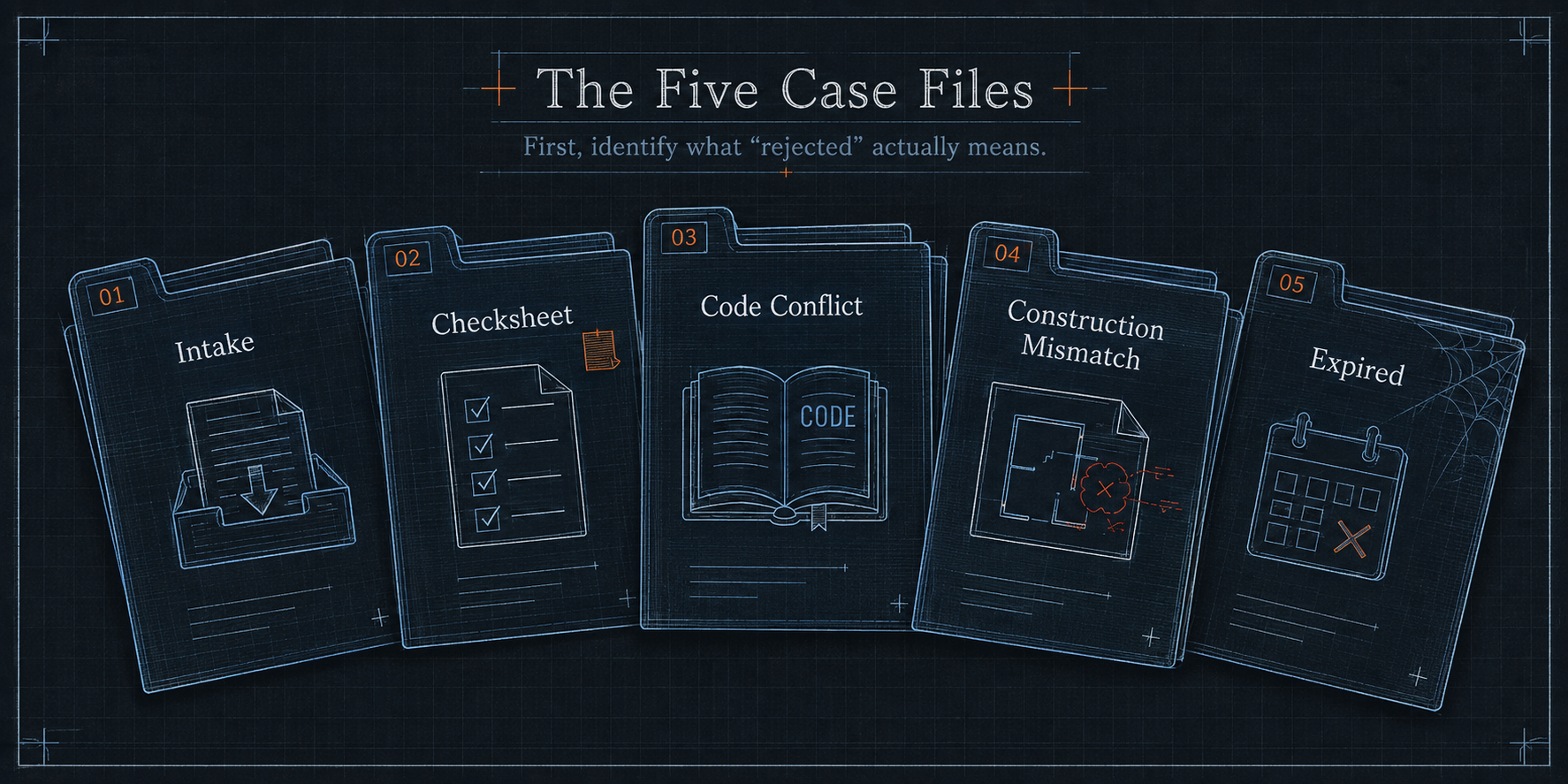
One status can mean five different problems — and each one has a different fix.
The checksheet is not the project. The portal status is not the project. Each is a record of a specific issue or decision that still needs to be resolved—and once the real issue has a name, the path forward is usually narrower than it first appeared.
Frequently Asked Questions
How long can a permit sit inactive before it expires in Oregon?
For issued residential permits, Oregon uses a 180-day standard: a permit expires if work has not started within 180 days of issuance, or if work is suspended or abandoned for 180 days after it begins. Other permit and application statuses may have their own local procedures. Request an extension before the deadline and confirm the requirements with the jurisdiction administering your permit.
Can an expired Oregon building permit be reactivated instead of starting over?
Sometimes. The answer depends on how long the permit has been expired, whether required inspections were approved, whether the scope has changed, and whether the jurisdiction can still verify completed or concealed work. Portland has a separate reactivation process, but older, substantially changed, or undocumented permits are more likely to require a new application.
My application was rejected before review even started. What does that mean?
Usually, the intake package was incomplete because of missing documents, unpaid initial fees, the wrong application type, or an unresolved land-use requirement. This is generally a completeness issue rather than a judgment on the design, and it may be resolved by supplying the missing information.
Can I appeal a plan reviewer’s interpretation of the code?
Potentially. Portland uses its Building Code Appeal process, while other jurisdictions use locally named alternate-method or appeal procedures. ORS 455.475 also provides a state-level appeal path for certain decisions involving the interpretation or application of Oregon specialty code provisions. The available path depends on the jurisdiction, the nature of the decision, and whether the issue is an interpretation, a proposed alternate method, or a land-use question.
Stuck on an Oregon Building Permit?
JR-DBA provides architect-led building-code and permit support for residential and light commercial projects throughout Oregon, with hands-on local process support strongest in Portland, Beaverton, Hillsboro, Washington County, and the surrounding metro area. Services may include permit-history review, permit-readiness review, code-trigger analysis, coordinated checksheet responses, revised drawings, and coordination with the appropriate engineers or reviewing jurisdiction.
Contact JR-DBA for a free initial consultation at Joshua@jr-dba.com or 971.217.7967.
Related Reading
Appeals, Variances, and Alternate Methods: What to Do When the Code Says No
ORSC or OSSC: Choosing the Right Oregon Code Path for ADUs and Duplexes
Permit Fees in Oregon: Plan Review, Reinspection, SDCs, and Other Costs That Surprise Owners
Author Note
Joshua Richards is the principal of JR-DBA. His credentials include ICC certifications as a Commercial Building Inspector, Commercial Plans Examiner, Residential Building Inspector, and Residential Plans Examiner. JR-DBA provides architectural design, building-code and permit support, commercial due diligence, and owner representation across Oregon and Southwest Washington. Reach out at Joshua@jr-dba.com, call 971.217.7967, or learn more at jr-dba.com.
