
How Much Does an Owner's Representative Cost in Oregon? Fees, ROI, and the Washington County Math

An owner’s representative fee should follow the scope of work. Preconstruction, active construction, and closeout services each add real tasks, coordination, and oversight.
Every homeowner I talk to in Hillsboro, Beaverton, and the rest of Washington County asks some version of the same question before considering an owner's representative: “What will this cost, and is it worth it?”
It is a fair question, and it deserves more than a vague “it depends.” The useful answer is that an owner's representative's fee should be tied to the work being performed: the project phases covered, the duration and frequency of involvement, the number of decisions being coordinated, and the risks the owner wants help managing.
I have written separately about what an owner's representative actually does and how that role differs from a general contractor. This article focuses on how owner's representative fees are structured, what drives the scope up or down, and how to evaluate the value without relying on a generic percentage or a promised return.
The short answer: Owner's representation may be priced as a fixed or phase-based fee, an hourly limited-scope engagement, or a monthly advisory retainer during active construction. Some firms use a percentage of construction cost. The right structure depends on whether the assignment is a defined review, recurring oversight, or an open-ended problem that still needs to be diagnosed.
Owner's Representation · Preconstruction Review · Construction Oversight
JR-DBA provides architect-led owner advocacy for custom homes, major remodels, additions, and select small commercial projects throughout the Portland metro area.
Discuss your project with JR-DBA →
Common Owner's Representative Fee Structures
There is no universal fee schedule for owner's representation. The AIA's current owner–owner's representative agreement instructions recognize multiple compensation methods and make clear that the method and amount are business decisions for the owner and representative.
The structure matters because it determines what is included, how predictable the fee will be, and what happens when the project changes.
Fixed or Phase-Based Fee
A fixed fee works well when the scope and deliverables can be clearly defined. Examples include a preconstruction document review, contractor bid comparison, permit-readiness review, contract-scope review, or oversight through a specific project phase.
The benefit is predictability. The limitation is that the proposal must state its assumptions. If the construction schedule extends, the number of meetings grows, or the project requires services outside the original scope, the agreement should explain how that additional work will be authorized and billed.
Hourly or Not-to-Exceed Engagement
Hourly billing is often appropriate for a narrow assignment or an issue whose effort cannot yet be predicted: reviewing one contractor proposal, analyzing a disputed change order, assessing a stalled permit, or advising at selected construction milestones.
For better cost control, the owner can ask for a not-to-exceed limit, a defined initial assessment, or written approval before the representative exceeds an agreed number of hours. Hourly work is most useful when the question is specific and the stopping point is clear.
Monthly Advisory Retainer
A monthly retainer can fit active construction, when meetings, site observations, payment applications, change orders, and owner decisions recur throughout the job. It provides predictable access and continuity without trying to price every email or meeting separately.
The agreement should still identify what the retainer includes: anticipated meeting and site-observation frequency, document reviews, reporting, response expectations, and the treatment of work beyond the agreed level of service.
Percentage of Construction Cost
Some owner's representatives calculate their fee as a percentage of construction cost. This is simple to scale, but the owner should ask two questions: Does the fee increase when the construction budget or approved change orders increase, and does a higher project cost actually create a corresponding increase in services?
A percentage is not inherently right or wrong. It is simply less informative than a defined scope unless the agreement also explains the service level, duration, deliverables, and limits. JR-DBA generally structures engagements around defined services—fixed or phase-based fees, monthly retainers, or hourly limited-scope support—rather than tying compensation automatically to construction cost.
What Drives the Cost Up or Down?
The construction budget is only one indicator of project scale. These factors usually have more influence on the owner's representative's actual workload.
1. When the Representative Joins the Project
An early engagement may include feasibility, design coordination, permit strategy, bid review, contract-scope review, and construction oversight. A representative hired after construction begins has fewer phases to cover, but may need more concentrated effort to understand decisions and risks already embedded in the drawings, contract, schedule, and work in place.
Earlier involvement does not automatically mean a higher total fee. It can allow the work to be divided into clear phases and gives the owner more opportunities to resolve scope gaps before they become field decisions.
2. Duration and Level of Involvement
A monthly progress meeting and several milestone site observations require a different commitment than weekly coordination, routine schedule tracking, payment-application review, change-order analysis, and owner decision management. The proposal should connect the fee to an anticipated cadence rather than use broad language such as “construction oversight” without defining it.
3. Project and Team Complexity
A contained remodel with a complete drawing set and one general contractor needs less coordination than a whole-house renovation or custom home involving structural, civil, mechanical, interior, landscape, and specialty consultants. Multiple owner-direct vendors or separate prime contractors also increase communication and decision tracking.
Complexity is not just the number of trades. It is the number of interfaces where scope, schedule, or responsibility can become unclear.
4. Existing Conditions and Document Readiness
Renovations carry uncertainty because concealed conditions may not be known until work begins. Incomplete drawings, unresolved selections, broad allowances, or an underdeveloped contractor proposal create additional decision volume as well.
An architect with plans-examiner and building-inspector credentials can help identify the governing issue, determine which professional needs to respond, and coordinate a documented path forward. Those credentials do not replace structural engineering, contractor responsibility for means and methods, or approval by the authority having jurisdiction.
5. Permit and Jurisdiction Coordination
The reviewing authority and submittal process depend on the property's location and the work involved. The City of Hillsboro, City of Beaverton, and Washington County maintain distinct permit systems and review workflows; Washington County, for example, uses ProjectDox for its plan-review submittals.
Good permit coordination means researching the issue first, preparing complete information, and bringing the assigned reviewer a focused project-specific question when interpretation is genuinely needed. Jurisdiction staff should not be treated as the project's design team or as a substitute for coordinated professional analysis.
6. Schedule Pressure and Response Expectations
A planned review with reasonable turnaround is different from a project-rescue assignment where work is stopped, a payment decision is due, or a change order needs an immediate response. Urgency can compress research, coordination, and documentation into a shorter period and should be addressed directly in the scope.
What Should an Owner's Representative Proposal Include?
A useful proposal makes the fee understandable before work starts. It should identify:
The project phases and specific services included
The expected duration of the engagement
The number or frequency of meetings and site observations
Which documents will be reviewed, such as bids, schedules, payment applications, change orders, and closeout materials
The form and frequency of written reporting
What is excluded or treated as an additional service
Hourly rates, retainer limits, or other terms that apply beyond the base scope
Reimbursable expenses and consultant costs, if any
The representative's authority—and decisions that remain with the owner
How either party may pause or end the engagement
If the proposal says only “owner's representation” without defining the service level, it is not detailed enough to compare with another proposal.
How to Evaluate the Return Without Assuming Guaranteed Savings
The wrong question is whether an owner's representative can guarantee savings greater than the fee. No responsible advisor can promise that every project will produce a particular financial return.
A better question is: Which decisions and risks would otherwise be managed by the owner without independent technical review?
Depending on the scope, an owner's representative may help the owner:
Compare contractor proposals on a consistent scope and identify exclusions
Clarify allowances, contingencies, payment terms, and change-order procedures before signing
Review payment applications against documented progress
Evaluate the cause, scope, pricing support, and schedule effect of a proposed change
Track open decisions and identify coordination gaps before they affect field work
Document site observations and follow unresolved items through closeout
Coordinate focused permit questions and resubmittal information
Preserve the owner's time by organizing decisions and communication
Some of that value may appear as an avoided or reduced cost. Some may appear as fewer surprises, better documentation, clearer decisions, schedule protection, or work that more closely matches the owner's expectations. The point is not to promise that the service will “pay for itself” after one issue. The point is to decide whether the project's exposure justifies independent owner-side support.
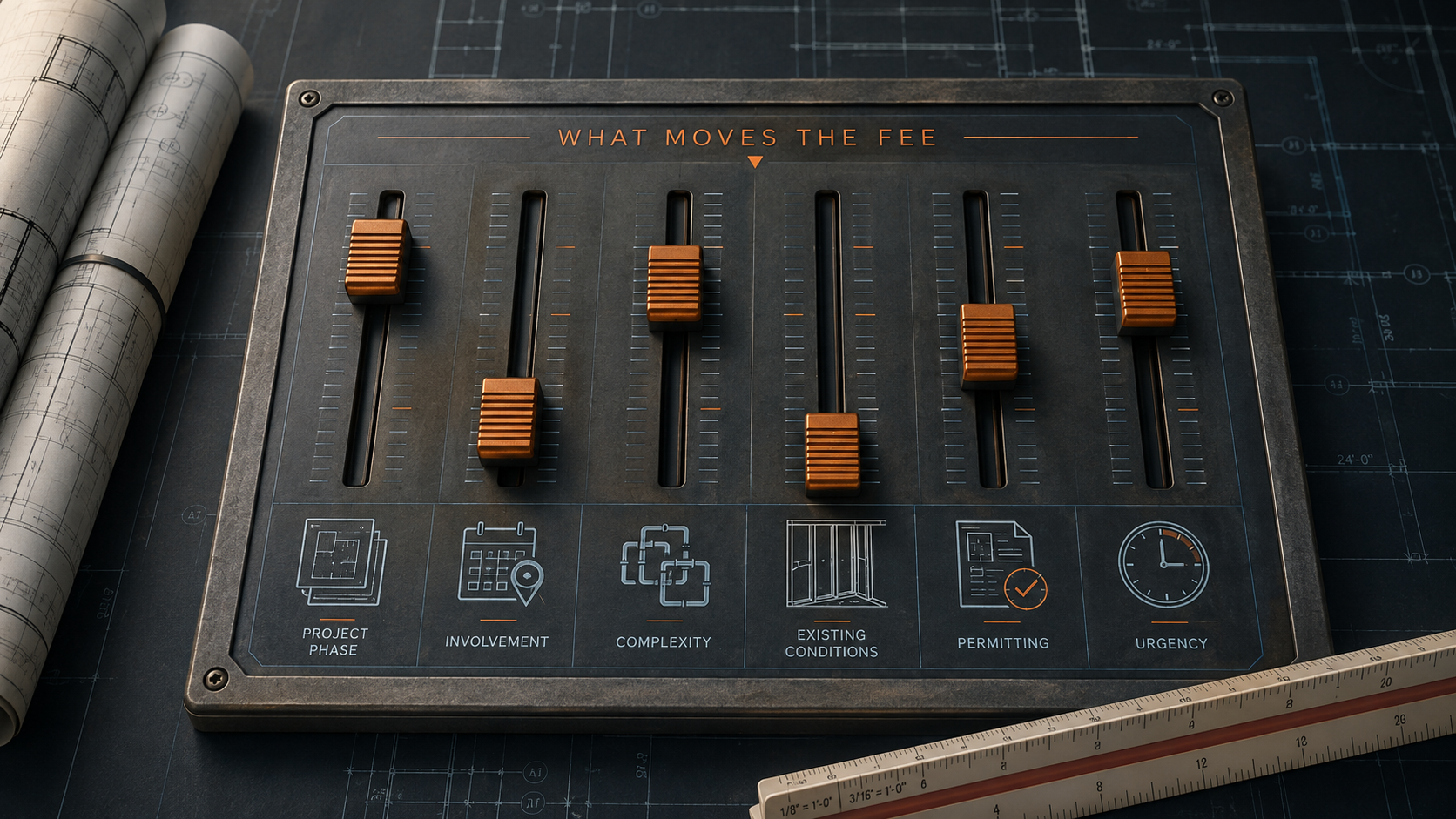
Owner’s representative fees move with scope. Project phase, level of involvement, complexity, existing conditions, permitting demands, and urgency all affect the amount of work required.
Site observations are also not continuous inspections and do not transfer the contractor's responsibility for construction means, methods, sequencing, or site safety. The agreement should describe those boundaries clearly.
When Full-Service Owner's Representation Makes Sense
Broader involvement is often worth considering when:
The project is a custom home, major remodel, addition, or complex tenant improvement
Structural work, existing-building uncertainty, or multiple consultants are involved
The owner has not worked with the contractor before
Several trades or owner-direct vendors must be coordinated
The owner is remote, time-constrained, or unfamiliar with construction documentation
Quality expectations are high and decisions need consistent follow-through
The contract contains broad allowances, unclear exclusions, or an undefined change-order process
If those last issues are already visible, review what to look for before signing a construction contract before work begins. An owner's representative can review technical scope and project controls, but questions about legal rights, indemnity, or enforceability belong with a qualified construction attorney.
When a Limited Engagement May Be Enough
Not every project needs continuous representation. A focused engagement may be more appropriate when the scope is simple and well documented, the owner has time and relevant experience, the architect and contractor have an established working relationship, and only a few independent checkpoints are needed.
That could mean preconstruction bid and contract-scope review, an initial construction meeting, selected milestone site observations, or review of change orders above an owner-defined threshold. A good proposal should fit the actual risk instead of adding process the project does not need.
The Bottom Line
The cost of an owner's representative in Oregon should not be reverse-engineered from the construction budget alone. It should follow a defined scope: what the representative will review, how often they will participate, what decisions they will help the owner make, and where their responsibility begins and ends.
For Hillsboro, Beaverton, and Washington County owners, the most useful next step is not asking for a generic percentage. It is providing enough project information for a scope-based proposal and comparing that scope with the risks you would otherwise manage yourself.
Request a Scope-Based Proposal
Planning a custom home, major remodel, addition, or small commercial project? Review JR-DBA's owner's representation services or schedule a structured consultation.
To make the initial conversation productive, include the project address, current phase, anticipated schedule, status of the drawings and construction contract, and the specific decisions or risks you want help managing.
Joshua Richards, Principal
JR – Design Build Architect
Joshua@jr-dba.com | 971.217.7967
