
Appeals, Variances, and Alternate Methods: What to Do When the Code Says No
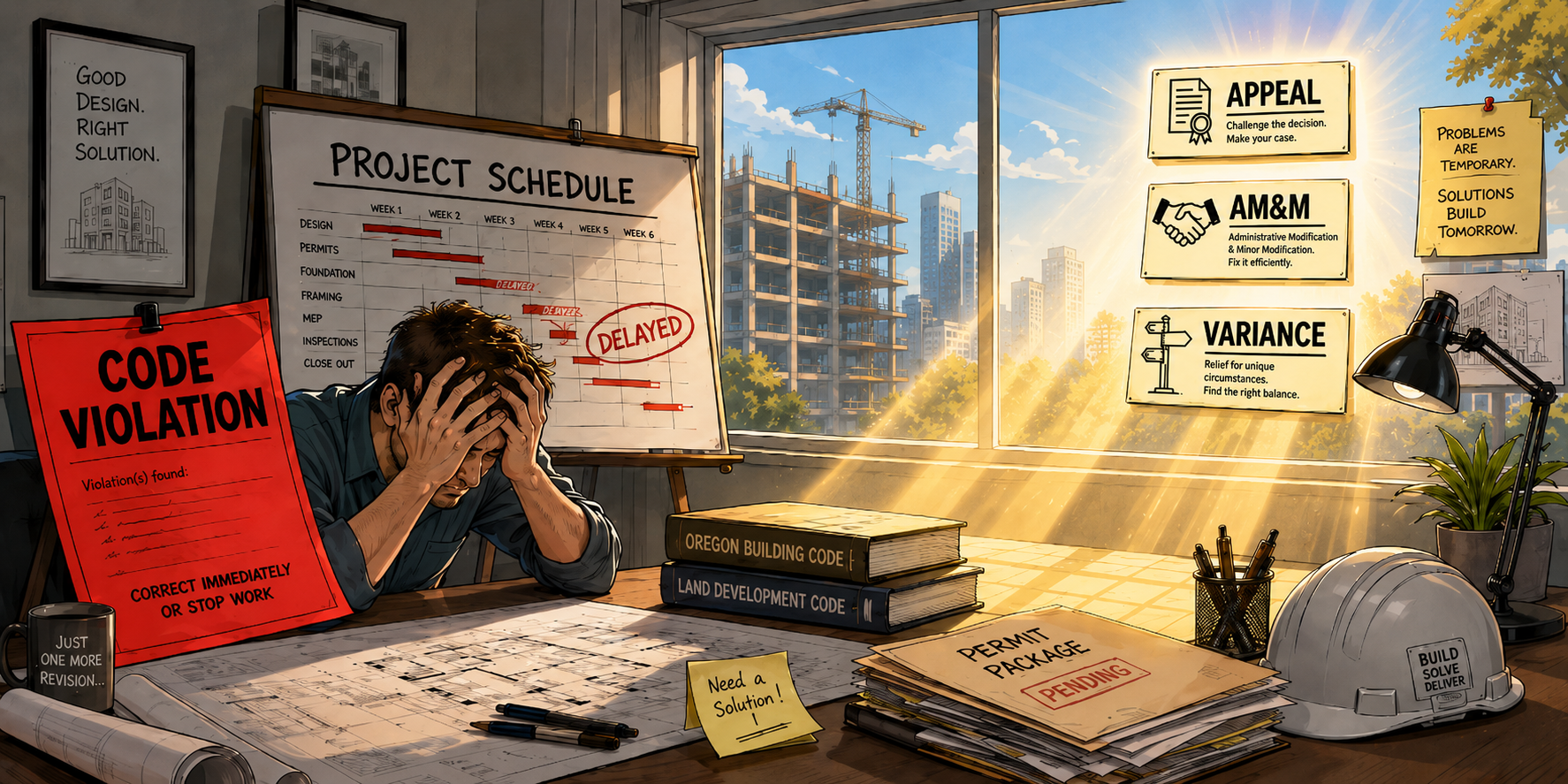
A project delay is not always the end of the road. In Portland, code issues may lead to different resolution paths, including an appeal, an Alternate Means and Methods request, or a variance, depending on the problem.
Somewhere in the Portland metro, a project is currently at a standstill because of one plan review comment: “Proposed design does not comply. Revise and resubmit.”
Building Code Appeals · Alternate Methods · Permit Support
When a project encounters a noncompliant condition—or the prescriptive code path is impractical, overly disruptive, or poorly suited to the existing building—JR-DBA helps evaluate the available options.
We coordinate with the appropriate structural, fire protection, mechanical, or other specialty engineers to develop a technically supported alternative or performance-based solution, document the equivalency argument, and present it clearly to the authority having jurisdiction.
To an owner or a project team, those words can feel final. But they may instead signal the start of a code-resolution process, and an opportunity to develop a workable alternative.
The Oregon building code was written by people who understood that no prescriptive rulebook can anticipate every building, every site, and every renovation condition. Its administrative chapters therefore give building officials several distinct powers: to interpret the code, modify its strict application in an individual case, approve alternative materials and methods, and issue decisions that can be formally reviewed.
These aren't loopholes. They're the code working as designed. But because most applicants never use them, owners routinely pay for expensive prescriptive fixes that a well-documented alternate request would have made unnecessary. Redesign is often the right answer. It just shouldn't be the only answer anyone considered.
This post explains those tools, shows where the ICC books deliberately allow performance-based design, and looks at how Portland, Beaverton, Washington County, Hillsboro, Tigard, and Clackamas County actually process these requests — because the underlying authority is similar, but the local terminology and filing procedures are not.
“A checksheet that says ‘not permitted’ is the beginning of a formal process — not the end of one.”
Three Terms That Do Not Mean the Same Thing
Before anything else, get the vocabulary straight, because filing the right technical argument through the wrong process can cost you months. Owners often use variance, appeal, and alternate method interchangeably. The system does not. The complication is that the name of the local form does not always match the legal function of the request. Portland is the clearest example: its Building Code Appeal is the administrative doorway for several different types of code decisions, including the city's version of an alternate means and methods request.
• A variance is a land use tool — the setback variance is the classic example. It asks the planning side of government for relief from a zoning or development standard, such as a setback, height limit, lot coverage requirement, or parking standard. Portland generally calls comparable zoning relief an adjustment rather than a variance. Either way, the request is decided under the local land use code, proceeds on the land use review track, and may be appealed through the land use system. A building official cannot solve a zoning setback problem through the building code appeal process.
• An appeal is generally a formal request for review of a building official's interpretation or decision. In many Oregon jurisdictions, that is the ordinary meaning: you believe the code was interpreted or applied incorrectly and you want a higher-level written decision. Portland uses the word more broadly. A Portland Building Code Appeal is the city's umbrella administrative process for confirming a code interpretation, requesting a modification to the strict application of a requirement, or proposing an alternative material, design, or method of construction. Because the decision is written and tied to the project, it can also create the formal record of the approved design conditions, compensating measures, and any additional requirements imposed as part of the approval.
• An alternate means and methods request — AMMR for short, although the label changes by jurisdiction — is the substantive building-code path for proposing a different way to satisfy the code. You accept the purpose of the requirement, but propose an alternative material, design, or construction method that is not the prescriptive solution described in the code. The applicant must demonstrate that the alternative meets the code's intent and provides an equivalent level of performance and safety. In Portland, this technical request is normally submitted and decided through the Building Code Appeal process. Closely related is a code modification, which asks the building official to adapt the strict application of a requirement to an individual case because practical difficulties or special circumstances make literal compliance impractical without reducing health, accessibility, life safety, fire safety, or structural protection.
Put plainly: a variance or adjustment addresses a land use standard. An alternate method establishes equivalency under the building code. A code modification addresses the strict application of a requirement in a specific case. An appeal provides a formal decision or review process — and in Portland, appeal is also the name of the administrative container used to process and record all three building-code issues. The alternate method is what you are asking the city to approve; the Portland appeal is how that request is filed, evaluated, conditioned, and documented.
New to the split between the land use system and the building permit system? Start with the first post in this series, Land Use First, Building Permit Second. Everything in this article lives on the building-code side of that line — except variances, which is exactly why owners confuse them.
That distinction matters in practice. A setback problem belongs with planning as a variance or adjustment. A proposed alternative to a fire-resistance assembly is an equivalency request — filed in Portland as a Building Code Appeal, but often called an AMMR elsewhere. A disagreement over what a code section actually requires is an interpretation appeal. And when Portland approves a project-specific alternate, the appeal decision can memorialize the exact design conditions and compensating measures that made the approval possible. That written decision does not replace a permit revision when the approved construction drawings themselves must be changed; the appeal establishes the code approval, while the permit documents must still accurately show the work.
Where the Code Itself Says Yes
People are often surprised that the authority to approve alternatives is not an informal courtesy from a friendly reviewer. It is printed in Chapter 1 of the Oregon Structural Specialty Code, alongside the building official's authority to interpret and enforce every other provision. The technical authority comes from the specialty code; the local jurisdiction decides what form, label, and administrative process applicants use to invoke it.
On the residential side, the 2023 Oregon Residential Specialty Code carries it in Section R104.11, Alternative materials, design and methods of construction and equipment: the building official shall approve an alternative that complies with the intent of the code and is at least equivalent to the prescribed requirement in quality, strength, effectiveness, fire resistance, durability, and safety. Its neighbor, Section R104.10, authorizes case-by-case modifications where practical difficulties make strict compliance impractical, so long as health, life, and fire safety aren't diminished. Notice the verb: once equivalency is demonstrated, approval isn't framed as a favor.
On the commercial side, the 2025 Oregon Structural Specialty Code — mandatory for all new applications since April 1, 2026 — carries the same duties-and-powers structure in Section 104, and it goes a step further in Section 113, Means of Appeals. Oregon amends the model code's appeal provisions and reprints ORS 455.475 — the statute that lets an applicant appeal a building official's decision directly to the state — right in the code text. Read that again: the Oregon code includes its own instructions for appealing past the local jurisdiction.
Two things about the equivalency standard deserve emphasis. First, the burden is entirely on the applicant. The building official has no obligation to do your engineering, research your product listings, or imagine your justification. Second, equivalency is measured against the intent of the provision, not its letter — which is the entire reason the framework works. Your job is to name the hazard the section exists to control, then prove your alternative controls it at least as well. (The attribute list flexes by specialty code — the plumbing code adds sanitation, accessibility appears where it's relevant — but the architecture is identical across all of them.)
One clarification, because a common shorthand causes trouble: an AMMR is not necessarily a performance-based design. That's reasonable shorthand — some alternates do rest on fire modeling or a full engineered equivalency analysis — but the technical meaning is broader, and the everyday AMMR is far more ordinary than the term suggests. It might be:
• An alternative listed assembly in place of the one the section prescribes.
• A product covered by an ICC-ES or other evaluation report rather than named in the code.
• An engineered fastening or structural detail.
• A different fire-protection arrangement supported by compensatory measures.
• Test data establishing equivalency for a specific condition.
• A material the prescriptive code simply doesn't mention.
What unifies the mundane examples with the sophisticated ones is the governing standard: the alternative must comply with the intent of the provision and be at least equivalent to the prescribed solution in the attributes that matter for it — strength, effectiveness, fire resistance, durability, safety, sanitation, accessibility, whichever apply. An AMMR is best understood as an equivalency request, not as permission to ignore a requirement. The code expressly allows the alternative once equivalency is demonstrated. In Portland, that equivalency analysis is presented inside the Building Code Appeal packet and becomes part of the city's written decision.
Which sections apply depends on which code governs your building. If you're not sure whether your project lives under the ORSC or the OSSC, that question comes first — it changes the review path, the submittal package, and the section numbers in every request you file. See ORSC vs. OSSC: Choosing the Right Oregon Code Path2.
Performance-Based Design: The Door the ICC Built Into Its Own Books
At the sophisticated end of the alternate spectrum sits true performance-based design. The ICC's model codes are prescriptive documents — assemblies with hourly ratings, travel distances in feet, fixture counts in tables — but the ICC has never pretended prescription is the only legitimate way to comply. Performance-based design enters through three layers of its own publications.
• The gateway. The alternative materials, design, and methods section — R104.11 in the residential code, the Section 104 provisions in the structural code — is the legal hook. It's what allows a jurisdiction to accept an engineered demonstration of performance in place of the cookbook, without anyone waiving anything. Every performance-based approval in Oregon ultimately hangs on this provision.
• The framework. The ICC also publishes the ICC Performance Code for Buildings and Facilities — a companion volume organized entirely around performance objectives (life safety, property protection, continuity of operations) and tolerable levels of damage, rather than prescriptive rules. Oregon has not adopted it as governing code, and almost no U.S. jurisdiction has. That's not really its job here. Its practical value on an Oregon project is as a structuring document: it gives your design team recognized language for defining objectives, design events, and verification methods when writing an alternate request, so the submission reads like an established methodology rather than an improvisation.
• The embedded provisions. Parts of the prescriptive code are already performance-based, hiding in plain sight. Smoke control systems are designed by rational analysis, not by table. Atrium and egress solutions routinely rest on fire and evacuation modeling. And on the structural side, the recognized standards themselves carry performance paths — most importantly ASCE 41, the seismic evaluation and retrofit standard for existing buildings, which is built entirely around selected performance objectives rather than new-building prescriptive force levels.
Where performance-based design earns its fee is almost always the existing building: a change of occupancy, an adaptive reuse, a structure where full prescriptive compliance is physically punishing or would destroy the thing worth saving. A fire protection engineer's timed egress analysis, or a structural engineer's ASCE 41 evaluation tied to a defined performance objective, can substitute a demonstration of actual performance for a prescriptive assembly the building simply can't accommodate.
It isn't free. Expect real engineering fees, a longer and more careful review, and possibly third-party peer review at your cost — jurisdictions are entitled to ask for it. Which is exactly why this is a financial decision, not a technical indulgence: you're weighing tens of thousands of dollars of analysis against the construction cost of the prescriptive fix it replaces. On the wrong project the math fails fast. On the right one, it isn't close.
How Six Local Jurisdictions Actually Handle It
The state specialty codes establish the core authority to interpret requirements, approve alternatives, and grant limited case-specific modifications. What varies — sometimes dramatically — is the local administrative machinery. Oregon law preserves local administration and local appeal boards, so the same technical proposal may be called an AMMR in one jurisdiction, an Alternative Means & Methods request in another, and a Building Code Appeal in Portland. The label matters less than identifying exactly which authority you are asking the building official to exercise.
Portland
Portland uses the term Building Code Appeal broadly. It is the city’s formal process for requesting a code interpretation, a modification to the strict application of a requirement, or approval of an alternative material, design, method of construction, or piece of equipment. In many cases, an appeal is not a dispute with the plans examiner. It is simply the required process for reviewing and documenting a project-specific solution that falls outside the code’s ordinary prescriptive path.⁶
Appeals are submitted online with a written explanation, the applicable code sections, supporting drawings, and documentation showing how the proposed design meets the code’s intent. Complete applications submitted by Portland’s weekly deadline are generally reviewed the following week. The resulting decision becomes part of the permit record and may include specific approval conditions that must be incorporated into the construction documents.
As of July 2026, Portland lists fees of $748 for commercial appeals, including up to two appeal items; $183 for each additional commercial item; and $359 for residential appeals. A first reconsideration may generally be submitted with new or revised information without an additional appeal fee. Because appeals are reviewed on a regular weekly schedule, a well-prepared appeal can sometimes resolve an issue faster than redesigning the project and completing another full plan-review cycle.
Beaverton
Beaverton's Building Division operates under adopted administrative rules that draw the same two-track distinction the model code does — separating alternate materials, methods of design, and methods of construction (the equivalency track) from modifications granted for practical difficulties or unique circumstances. That's useful clarity: it tells you which Chapter 1 tool you're actually invoking before you write a word. The municipal code separately establishes a Board of Construction Appeals for disputes. In practice, the working process is a written alternate-method request to the Building Division, ideally teed up in a pre-submittal conversation before anyone's position hardens. There is no Portland-style published decision database, which means precedent lives in staff memory — and your documentation has to stand entirely on its own merits. Land use adjustments and variances run separately through the Beaverton Development Code's application procedures.
Washington County
Washington County Building Services enforces the state code for unincorporated Washington County under ORS 455 and the county charter, and it has its own vocabulary: the county's form is a Request for Alternate Methods, and it's one of the clearer intake documents in the metro. For interpretation disputes, the county doesn't run a Portland-style appeals machine; its building ordinance points specialty-code appeals toward the state's boards and chiefs, and the direct-to-state route under ORS 455.475 is always available — so the absence of local appeal machinery is less of a handicap than it sounds. What the county does have is a highly proceduralized land use side: director-level Type I and II decisions are appealable to a Hearings Officer, Type III applications go to public hearing, land use appeal windows are short (twelve days as of this article), and Clean Water Services adds its own standards layer for anything near a water resource. For unincorporated Washington County work, my consistent advice is to spend your energy on the pre-application conference. It's where alternate approaches get a genuine hearing before they cost anything.
Hillsboro
Hillsboro uses a formal Alternative Means and Methods process for proposed designs that differ from the code’s prescriptive requirements. These requests are reviewed by the building official and must clearly identify the applicable code provision, explain the proposed alternative, and demonstrate that it provides an equivalent level of performance and safety.
Fire-related requests may also require coordination with Hillsboro Fire & Rescue as part of the city’s development review process. Land use adjustments, variances, and related appeals remain separate procedures handled under Hillsboro’s Community Development Code.
Tigard
Tigard runs its own full Building Division — building official, in-house plans examiners, inspectors — so alternate method requests are handled locally by the same people who will inspect the work, which tends to make early conversation unusually productive. The municipal code's appeal provisions are aimed mostly at administrative actions and penalties, on tight clocks (at the time of this article roughly twenty days to file, a hearing within thirty, a written decision in ten); for a true code-interpretation dispute, the state ladder is the realistic second step. One land-use note worth knowing: Tigard publishes guidance on the mandatory adjustment provisions of Senate Bill 1537, which now requires cities to grant certain development-standard adjustments for qualifying housing projects. The variance side of the world isn't purely discretionary anymore, and Tigard has been explicit about how it's implementing that.
Clackamas County
Clackamas County publishes alternate means and methods application forms9 — but pay attention to the posture. The county's own materials state that use of the alternate provision is intended to be limited and considered carefully case by case, and its applications arrive with a policy memorandum and strict conditions attached, including the county's discretion to void permits if conditions aren't followed to the letter. Its published operating plan describes the escalation path — plan reviewer or inspector, then supervisor, then the building official — with further appeal to the state under ORS 455.475 and the administrative rules. The county also provides full building department services for several of its cities, including Gladstone, Canby, and Molalla, so this posture travels beyond the unincorporated areas. Translation: in Clackamas County, an alternate request needs to be airtight before it goes in, and the informal escalation conversation matters more than the form. Land use variances run separately under the county's Zoning and Development Ordinance, with Planning Director decisions appealable to the Land Use Hearings Officer.
Using These Tools Without Burning the Relationship
Here's the thing nobody puts on the application form: the officials reviewing today's request may review and inspect your next ten projects. That is not a reason to avoid formal tools — it is a reason to use them precisely. A Portland Building Code Appeal is not automatically an escalation; an alternate-method appeal may be the city's normal administrative path. What matters is the quality of the record. The code gives the building official explicit authority to approve interpretations, modifications, and equivalent alternatives. Your job is to make yes the clear, technically defensible answer.
This is where my ICC Plans Examiner and Building Inspector certifications, together with years of code consulting experience, become especially valuable. I have been brought into projects after an initial alternate-method request was denied—often because the equivalency argument was incomplete, the supporting documentation was weak, or the request created unnecessary friction with the authority having jurisdiction. A well-prepared request respects the reviewer’s time, addresses the actual code concern, and gives the building official a clear and defensible basis for approval. A few rules I follow on every request:
• Talk first. Portland's own guidance says to consult the plan reviewer or inspector before filing, and every suburban building division will tell you the same thing. Many apparent denials dissolve once the reviewer understands the proposed design. Even where a Portland appeal is the expected next step, the conversation helps define whether the request is an interpretation, a modification, or an equivalency proposal — and prevents the formal packet from solving the wrong problem.
• Match the writing to the authority you are invoking. For an interpretation appeal, identify the section, the decision, and why the code should be read differently. For a modification, describe the practical difficulty or special individual condition and show why the requested adjustment preserves the code's intent and required safety. For an alternate method, state the prescriptive requirement, identify the hazard or objective it addresses, describe the proposed design precisely, and demonstrate equivalency using listings, test data, engineering analysis, modeling, or compensating measures. In Portland, the appeal packet should also state every project-specific condition that needs to appear in the written approval. One issue per appeal item, with drawings prepared for the request itself rather than recycled permit sheets.
• Do the timing math. A Portland appeal turns in about a week. The state chief's decision runs on a fourteen-day statutory clock, and the statute pauses your plan review deadline while it does. Compare that — and the fee — against another full resubmittal cycle, a redesign, and the carrying costs of a stalled project. This is where permit management stops being a compliance exercise and starts being a financial and scheduling tool.
• Know when the answer really is redesign. If the alternative can't honestly meet the equivalency standard, don't file it. A weak appeal costs money, time, and — worse — credibility you will want on the next project. The most valuable thing an experienced advisor does here is tell you which fights are winnable.
The timing math only works if you know what delay actually costs. For the full picture of plan review fees, reinspection charges, SDCs, and the other numbers that stack up while a project idles, see Permit Fees in Oregon: Plan Review, Reinspection, SDCs, and Other Costs That Surprise Owners.
The Checksheet Is Not the Final Word
Every tool in this post exists because the people who wrote the code knew their book could not anticipate every building. Variances and adjustments address land use standards. Alternate methods and modifications provide documented building-code flexibility. Appeals provide formal review — and in Portland, the appeal process also serves as the administrative vehicle and written project record for those approvals. Owners who understand both the technical remedy and the local filing process make better decisions when a project stalls. Owners who do not often pay for redesigns that were never the only available path.
When a project encounters a noncompliant condition—or when the prescriptive code path is impractical, technically unsuitable, or disproportionately disruptive—JR-DBA helps evaluate the available options. We can coordinate with the appropriate structural, fire protection, mechanical, or other specialty engineers to develop a performance-based or alternative solution that addresses the code’s intent and provides the authority having jurisdiction with a clear, technically supported basis for approval. Schedule a free consultation.
Joshua Richards is the principal of JR-DBA, a Portland-based practice providing architectural design consulting, owner's representation, and permit and building code consulting across the Portland metro and Washington County. If you're budgeting a project and want the full fee picture — permit costs, SDCs, and the relief programs your project may qualify for — before you commit to a design, reach out at Joshua@jr-dba.com or 971.217.7967, or learn more at jr-dba.com.
Building Code and Permit Support series:
Oregon ADU Permit Timeline: How to Reduce Checksheets and Resubmittals
Permit Fees in Oregon: Plan Review, Reinspection, SDCs, and Other Costs That Surprise Owners
Appeals, Variances, and Alternate Methods (this post)
