

What Oregon’s residential contract rules cover—and how a clear change-order process helps protect your budget.
A change order often arrives when construction is already moving: an additional cost, a brief explanation, and a request to sign. It can feel like routine paperwork. But each approval can change both the amount you pay and the date your project is finished.
Changes are a normal part of construction. The risk comes when they move faster than the documentation—or when nobody checks whether the proposed extra was already included.
The original contract establishes the starting commitment. The change-order process helps you control how that commitment grows.
What a Change Order Actually Is
A change order records an agreed adjustment to the contract’s scope, price, schedule, or a combination of those items. It should explain what changed, why it changed, and how the adjustment affects the project.
Legitimate changes can include owner-requested upgrades, concealed conditions, revised design decisions, or additional work required by the permitting authority. They are not limited to conditions nobody could have anticipated. Whether a particular cost belongs to the owner or contractor depends on the contract, the reason for the change, and the responsibilities already assigned.
A higher-than-expected cost to perform unchanged work is not, by itself, a sufficient explanation for increasing a fixed contract price. Ask which contract provision or scope change supports the request.
What Oregon Requires—and What Your Contract Should Add
ORS 701.305 generally requires a written contract for construction, improvement, or repair of a residential structure when the aggregate contract price exceeds $2,000. If a contract starts below that amount and later exceeds it, the statute requires delivery of a written contract within five days after the contractor knows or reasonably should know the price will exceed $2,000.
That residential requirement should not be presented as a universal rule for every commercial construction contract. The Oregon Construction Contractors Board’s contractor guidance explains the residential contract requirements.
For changes, the CCB’s Guide to Home Improvement Contracts recommends documenting contract changes with a change order signed by both parties and recording any effect on cost. Its consumer guidance also recommends including a contract term requiring signed, written change orders.
The practical distinction: the residential written-contract requirement does not, by itself, establish the complete approval and pricing procedure you want for every change. Put that procedure in the contract and follow it throughout construction.
It would be too broad to say Oregon law provides no protection or that every unsigned extra is automatically payable—or automatically invalid. The agreement and the circumstances matter. For disputed authorization or payment obligations, an Oregon construction attorney should evaluate the specific facts.
Three Ways Changes Put Pressure on a Budget
1. Allowances that do not match the intended selections
An allowance is a placeholder, not necessarily the final installed cost. A $3,000 fixture allowance can look adequate until the actual selections, delivery, installation, and agreed markup are accounted for. Confirm what each allowance includes, how overages are calculated, and whether unused amounts produce a credit.
2. “While we’re in there” additions
Moving an outlet, upgrading a finish, or adjusting a wall can be worthwhile. Several small decisions can also consume the contingency. Ask for the full cost before deciding, including any related demolition, patching, engineering, or permit revisions.
3. Verbal decisions without a shared record
A job-site conversation can leave the owner and contractor with different understandings of what was authorized. Record the scope, price or pricing method, and schedule effect promptly. A clear written record protects both parties.
These problems do not require dishonesty or an inattentive owner. They can develop whenever decisions, pricing, and documentation are not coordinated.
How an Owner’s Representative Reviews a Change Order
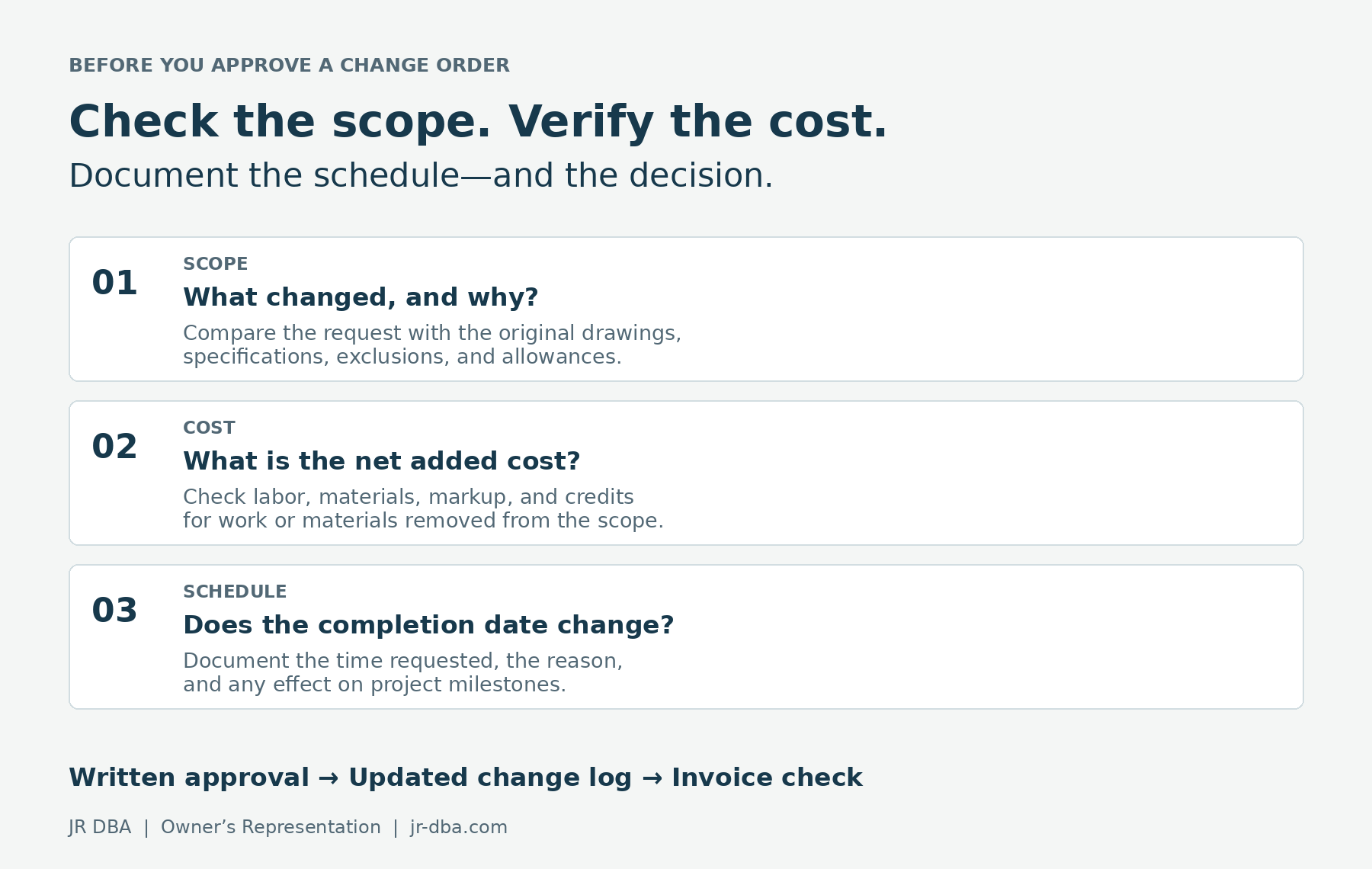
An owner’s representative helps you evaluate the proposed change before approval and checks the resulting billing against the agreement. The review should cover three connected questions.
Scope: Is this actually additional work?
Compare the request with the signed agreement, drawings, specifications, accepted proposals, exclusions, and allowances. Identify the cause of the change and ask whether the requested work duplicates something already included. If work is being removed or replaced, identify the corresponding credit.
Cost: Is the amount supported?
Request a breakdown appropriate to the size of the change: quantities, labor hours and rates, materials, equipment, subcontractor costs, and contractual markup. Compare it with agreed rates and available project pricing. Small or urgent additions may carry legitimate mobilization costs; the goal is an explained price, not an automatic assumption that every extra is overpriced.
Schedule: What does the change actually delay?
Ask which activities are affected, whether the work delays overall completion, and what procurement or inspection constraints are involved. Record any agreed extension and the revised completion date. An added task does not necessarily extend the project by the same number of days it takes to perform.
The representative makes a recommendation within the agreed service scope. The owner—or someone expressly authorized by the owner—makes the approval decision.
A Tighter Standard: Agree on the Process Before Work Starts
Before signing the construction agreement, establish a change-order procedure that addresses:
- Written scope and reason: identify the proposed work and the documents or conditions that triggered it.
- Transparent pricing: state the added cost, applicable markup, deductive credits, and resulting net adjustment.
- Schedule consequences: identify any requested extension and the revised milestone or completion date.
- Approval authority: name who can authorize changes and require written agreement before changed work begins, subject to clearly defined exceptions.
- Urgent or uncertain work: establish an emergency notification process and, when final pricing cannot be set in advance, a written time-and-materials authorization with agreed rates, daily records, and a not-to-exceed amount.
- One running record: track proposed, approved, rejected, and billed changes separately, along with the revised contract total and remaining contingency.
These are project-control recommendations, not a substitute for contract language tailored by legal counsel. On an active project, agree on improvements with the contractor rather than assuming new procedures can be imposed retroactively.
Track the Total, Not Just the Latest Request
Consider an illustrative $200,000 contract with $8,000 in approved additions and a $2,000 credit. The revised contract amount is $206,000. A separate $5,000 pending request is not yet part of that approved total, but it raises the potential exposure to $211,000 if accepted.
Track both numbers. Keep the owner’s contingency separate from the contract amount, and avoid treating it as money automatically available to the contractor. When an invoice arrives, match each billed change to its approval and applicable payment terms.
Questions to Ask Before You Sign
- Is this work already included in the contract, specification, or allowance?
- What caused the change, and who is responsible under the agreement?
- Does the price show labor, materials, markup, and any credit for omitted work?
- Is there a practical lower-cost alternative?
- Does the change affect completion, and is that impact documented?
- What will the revised contract total and remaining contingency be?
- Would I still choose this change if I saw its full cost and schedule impact together?
Protecting the Budget You Already Approved
A good change-order process does not prevent every added cost. It makes the decisions visible while you can still evaluate alternatives. Scope review, documented pricing, clear authorization, and a current budget log help keep reasonable changes from becoming avoidable surprises.
JR DBA’s Oregon owner’s representation services can support that process before construction begins or during an active project, with the engagement tailored to the decisions in front of you.
This article provides general construction-management information, not legal advice. Contract interpretation and disputed payment obligations should be reviewed with an Oregon construction attorney.
Ready to Move Your Project Forward?
If you’re planning an Oregon residential or light commercial project—or reviewing extra costs on a project already underway— JR DBA can help evaluate scope, allowances, pricing, and the change-order process before your next commitment.
Schedule a Change Order Review →
Joshua Richards, AIA
Principal | JR Design Build Architect (JR DBA)
Licensed Architect
ICC Certified Commercial & Residential Building Inspector
+ Plans Examiner
Residential Design | Building Code & Permit Support
| Owner’s Representation
www.jr-dba.com | Joshua@jr-dba.com | 971.217.7967
Service Area: Oregon and Southwest Washington—including Portland, Beaverton, Hillsboro, Tigard, Lake Oswego, Washington County, Vancouver, Camas, and Battle Ground. Projects outside these areas are considered case by case.
