
Why Good Architects and Contractors Still Deliver Bad Projects
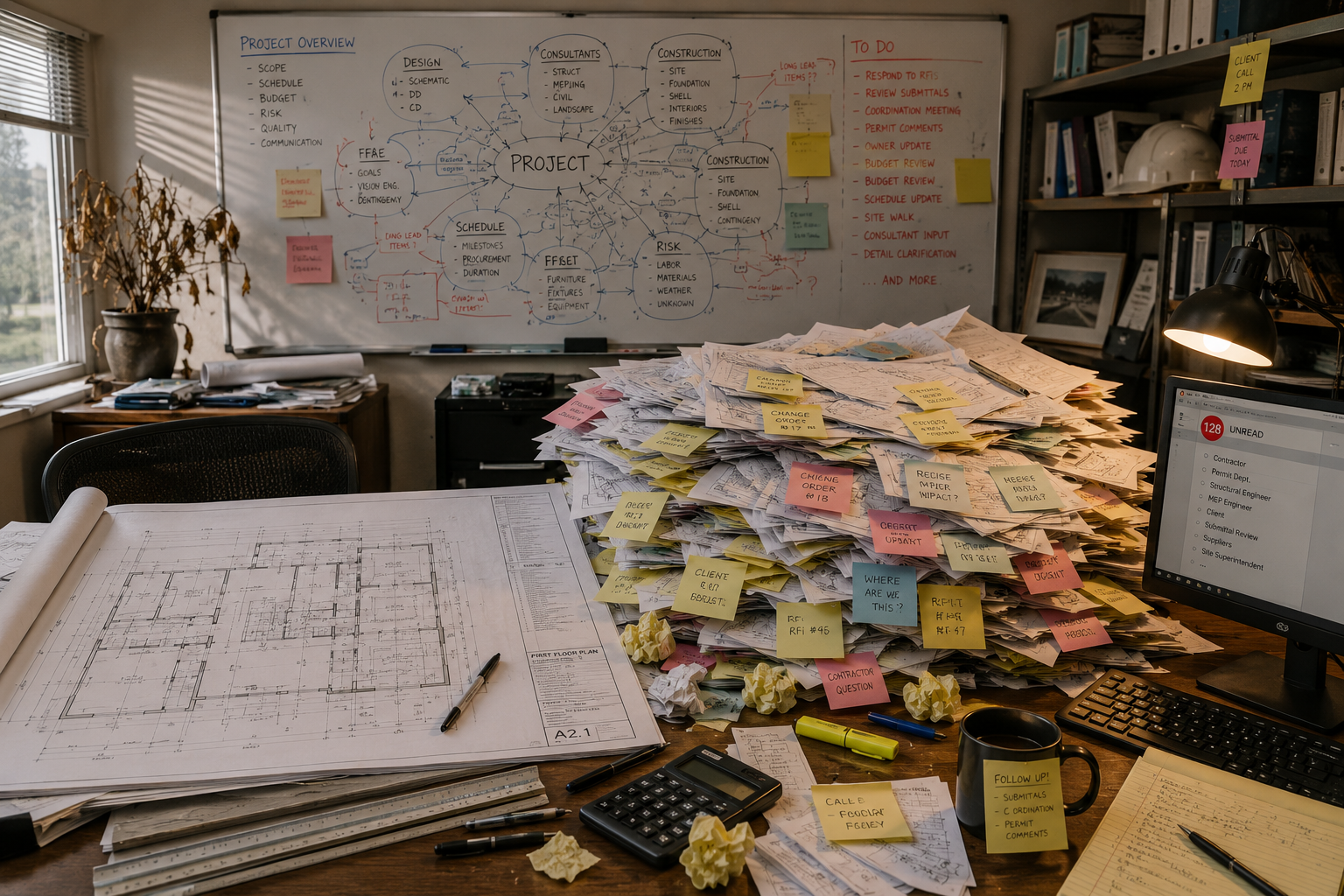
Even experienced project teams can struggle when workloads exceed capacity. As project demands increase, communication, quality control, and schedule management often begin to suffer.
Most homeowners assume that if they hire a reputable architect and a well-reviewed contractor, their project will be delivered on time, on budget, and with excellent quality.
That assumption comes from the best intentions of everyone involved. Unfortunately, it is often wrong.
A significant percentage of residential construction projects experience schedule delays, budget increases, or quality failures—not because the professionals involved were incompetent or unethical, but for a reason far more mundane and far more preventable.
The Primary Reason Why Good Teams Have Projects That Struggle
Most project problems aren't caused by bad actors.
They're caused by too much work and not enough time.
Owner's Representation · Due Diligence · Feasibility Review
JR-DBA provides owner-side due diligence, existing building assessments, and early feasibility reviews to help clients understand potential code, seismic, and permitting considerations before moving forward. If you're evaluating an older masonry building — whether for purchase, renovation, or adaptive reuse — early assessment is the right starting point.
The design and construction industry runs in economic cycles. Work arrives in waves. During strong market periods, firms receive more opportunities than they can comfortably absorb. During downturns, projects can disappear almost overnight.
Because no one knows exactly when the next slowdown is coming, most firms try to secure as much work as possible when the market is active. This isn't greed—it's survival. But every additional project requires time, attention, coordination, and quality control. And every company eventually reaches the point where resources become stretched.
When that happens, quality is usually the first thing to slip.
One of my early mentors put it plainly: "Never turn down a project. If you are too busy and don't want it, bid it high enough that you can’t refuse it." At the time, that seemed like strange advice. Over the years, it's come to describe a reality that nearly every professional in this industry navigates.
How Good Firms Become Overloaded
Most architects and contractors start with the best of intentions. They want excellent outcomes. They want satisfied clients. They want projects they're proud of.
And yet even firms with strong leadership and talented staff face the same structural challenge: there are only so many hours in a day.
As workloads increase, project managers absorb more files. Senior staff spend less time on direct review. Meetings get shortened. Emails sit longer. Quality control becomes rushed.
None of those decisions are usually malicious. They're symptoms of an overloaded system—and they produce disappointing outcomes even when the people involved are genuinely skilled.
Why Smaller Projects Can Get Left Behind
Many owners don't realize how projects are actually staffed inside a larger firm.
High-profile commercial work, major custom residences, and institutional projects tend to attract the most experienced project managers, senior architects, and company leadership attention. These projects matter most for revenue, reputation, and future marketing.
Meanwhile, smaller-scale work—custom home remodels, additions, ADUs, tenant improvements, small commercial renovations—is frequently assigned to junior staff working under the general supervision of senior personnel. There's nothing inherently wrong with that model. It's one of the primary ways young professionals develop their skills.
The problem occurs when supervision becomes nominal because senior staff are already managing too much. When that happens, smaller projects receive less attention than their owners expect—or deserve.
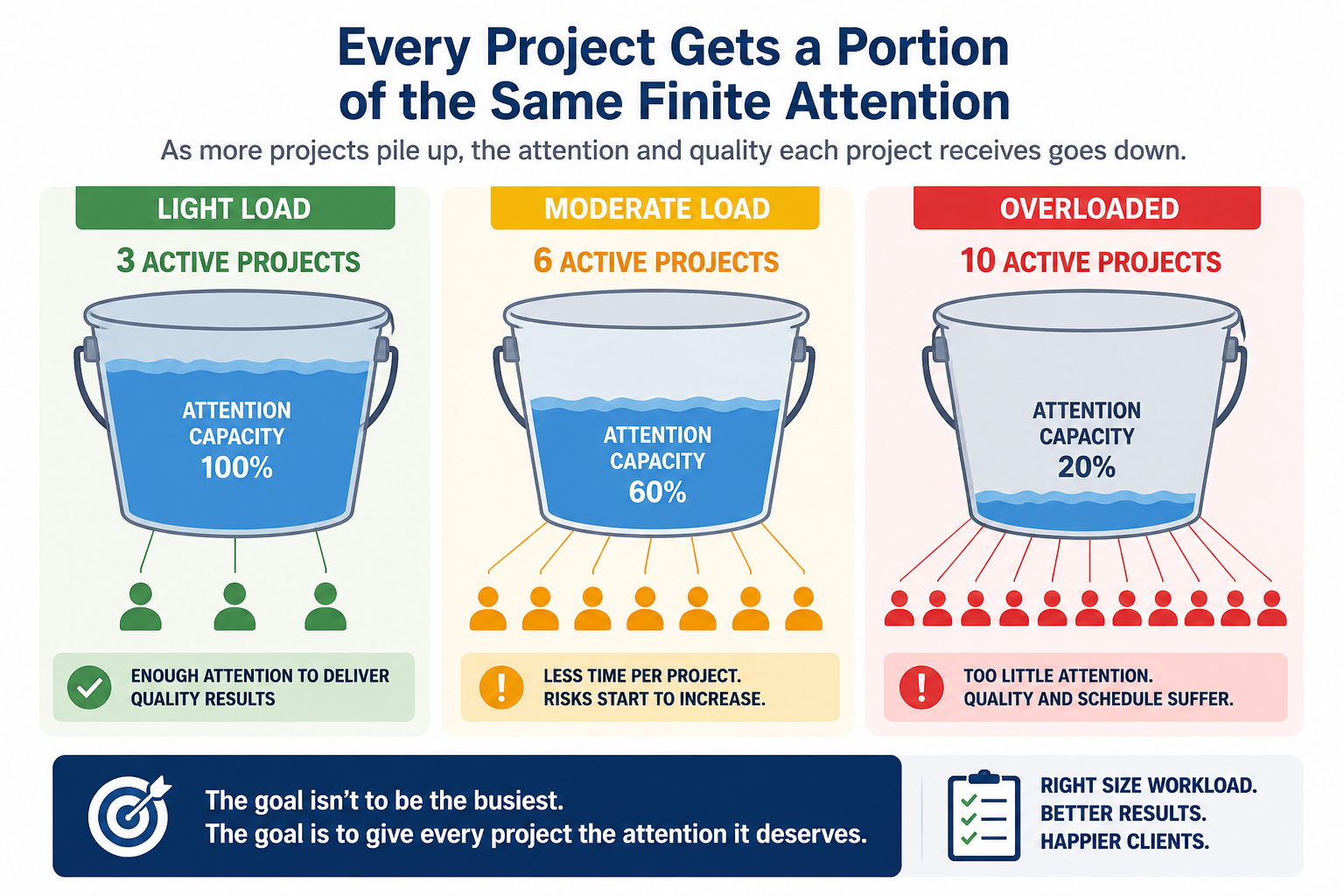
As architects, contractors, and project managers take on additional work, the amount of attention available for each project decreases. Understanding this relationship helps owners identify potential risks before quality and schedule issues emerge.
Warning Signs Worth Watching For
Most owners recognize when a project has completely collapsed. The harder and more valuable skill is spotting the warning signs early—before delays compound and costs escalate.
Watch for patterns like these:
Response times are increasing
Commitments or deadlines are being missed
Meetings are being frequently rescheduled
Permit review comments surface issues that should have been caught in design
Change orders are arriving in clusters
Contractors are waiting on information before they can proceed
The same design elements are being revised repeatedly
Senior staff have largely stopped attending project meetings
Decision makers have become difficult to reach
One or two of these in isolation may be manageable. Several appearing together is a signal that the project team may be operating beyond its capacity—and that your project may be absorbing the consequences.
What to Ask Before You Sign
Owners have more leverage before a contract is executed than at any other point in the process. Use it.
Ask who will actually work on your project. You're not hiring a firm's reputation—you're hiring specific people. Ask for the name of your project manager, your primary design contact, and your field superintendent. Ask about their experience and how long they've been with the company. Ask to see similar completed projects.
Ask about quality control. Every professional firm should have some form of internal review before work goes out. Who signs off on drawings before permit submission? How often are senior staff directly involved? What happens if errors are caught after the fact? The answers reveal how a firm actually operates.
Ask for a preliminary schedule. Construction involves uncertainty—no one can predict every delay. But experienced professionals should be able to describe major milestones, typical permitting durations for your jurisdiction, and key decision points where your input will be required. A team that can't articulate a realistic schedule may not have a clear plan.
Ask about current workload. This is an uncomfortable question, and that's exactly why it's worth asking. You don't need exact numbers. You need to hear whether the team has thoughtfully considered how your project fits into what they're already managing. A confident, specific answer is a good sign. A vague one is worth noting.
The goal isn't to find a perfect architect or contractor. Perfect firms don't exist. The goal is to understand how projects are staffed, managed, and monitored—so your project receives the attention it deserves.
When a Project Is Already in Trouble
Even well-planned projects run into difficulties. Schedules slip. Budgets shift. Communication breaks down.
When that happens, owners often find themselves caught between multiple parties, each managing their own relationships and interests. The architect wants to preserve the contractor relationship. The contractor wants to preserve the architect relationship. Consultants are focused on their individual scopes. Everyone has competing priorities.
The question worth asking at that moment is: who in this room is solely focused on protecting your interests?
JR-DBA Owner's Representation When a project starts showing signs of stress—missed milestones, unresolved change orders, communication gaps—an Owner's Representative can step in to reestablish accountability and bring the project back on track. JR-DBA provides owner-side oversight for Portland-area residential and commercial projects at any stage. Learn more about Owner's Representation services →
The Case for Independent Owner-Side Oversight
An Owner's Representative works exclusively for the owner. Unlike the architect, contractor, or any member of the consultant team, an Owner's Rep has a single responsibility: protecting the owner's investment.
Depending on where a project stands, that can include feasibility review, building code and permitting guidance, budget and schedule oversight, design coordination, construction observation, and quality assurance review. But the most underappreciated benefit of owner's representation isn't any specific service—it's accountability.
The presence of an experienced, independent third party tends to sharpen everyone's focus. Response times improve. Commitments get met more consistently. Issues get escalated and resolved rather than deferred.
That dynamic shift happens not because the architect or contractor is suddenly working harder, but because the project now has a dedicated advocate whose only job is to make sure things don't fall through the cracks.
🔗 Related reading:What Does an Owner's Representative Actually Do? — A breakdown of the specific services, decision points, and project stages where owner's representation adds the most value for Portland homeowners.
The Bottom Line
Great projects don't happen by accident.
They happen when accountability, communication, and experience are present from concept through construction—and when someone is actively watching out for the owner's interests throughout the process.
Most architects and contractors genuinely want successful outcomes. The reality is that even talented, well-intentioned professionals can struggle when workloads become excessive. Knowing how to recognize the early warning signs, ask the right questions before hiring, and bring in independent oversight when it matters most gives owners a meaningful advantage—regardless of market conditions or project scale.
Joshua Richards, Principal, JR-Design Build Architect Portland, Oregon — Owner's Representation | Architecture | Permit Consulting jr-dba.com | Joshua@jr-dba.com
Have a project that's showing early warning signs? Schedule a project review →
More from JR-DBA Insights
