
Owner's Representative vs. General Contractor: What's the Difference and Do You Need Both?
Many homeowners assume their contractor already represents their interests throughout construction. After all, they're the person you hired, the person you're paying, and often the person making the day-to-day decisions on the jobsite.
That assumption comes from the best intentions of everyone involved—but it is often incorrect.
A general contractor's role and an Owner's Representative's role are fundamentally different. Understanding that distinction before a project begins can prevent costly misunderstandings and help owners make better decisions at every stage.
A general contractor is hired to build the project. An Owner's Representative is hired to protect the owner's interests throughout the project. Both are important—but they serve fundamentally different roles.
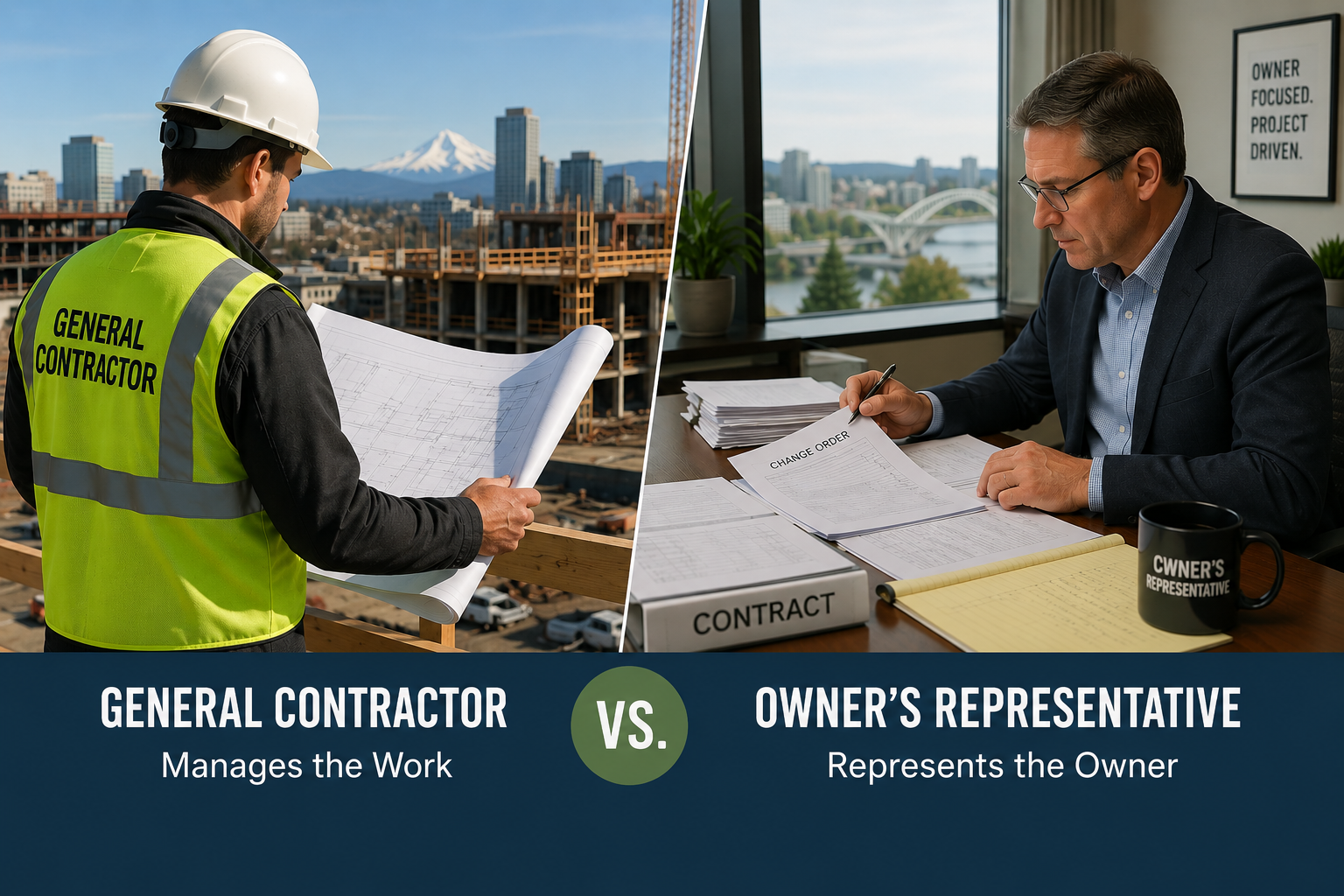
Both roles are essential to a successful project. The difference is who they work for. General contractors manage construction. Owner's representatives advocate for the owner's interests, helping navigate costs, contracts, risks, and project decisions throughout the Portland construction process.
What a General Contractor Actually Does
A general contractor is responsible for building the project. That scope is broad and demanding. On a typical residential project, the GC manages all subcontractors — framing, electrical, plumbing, mechanical, roofing, concrete, and finishes — coordinates deliveries, maintains site safety, sequences the work, and handles daily field operations from groundbreaking through final inspection.
That's a significant undertaking, and a skilled GC is one of the most valuable members of any project team.
But the GC's primary obligation is to the contract — completing the defined scope of work, on the agreed schedule, within the agreed price. That's not a criticism. It's simply the nature of the role. When circumstances change (and they always do), a contractor's decisions are naturally filtered through the lens of their own contract and their own business.
In Portland-area projects, this often appears because of jurisdiction-specific requirements. For example, Portland Permitting & Development (PP&D) has its own processes for utility coordination, historic review, and permitting approvals. Combined with unforeseen existing conditions, older-home renovations, and project changes that emerge during construction, these requirements can contribute to permitting delays, schedule impacts, and unexpected costs.
These issues aren't necessarily anyone's fault, but they frequently create situations where owners benefit from independent advice before making important decisions.
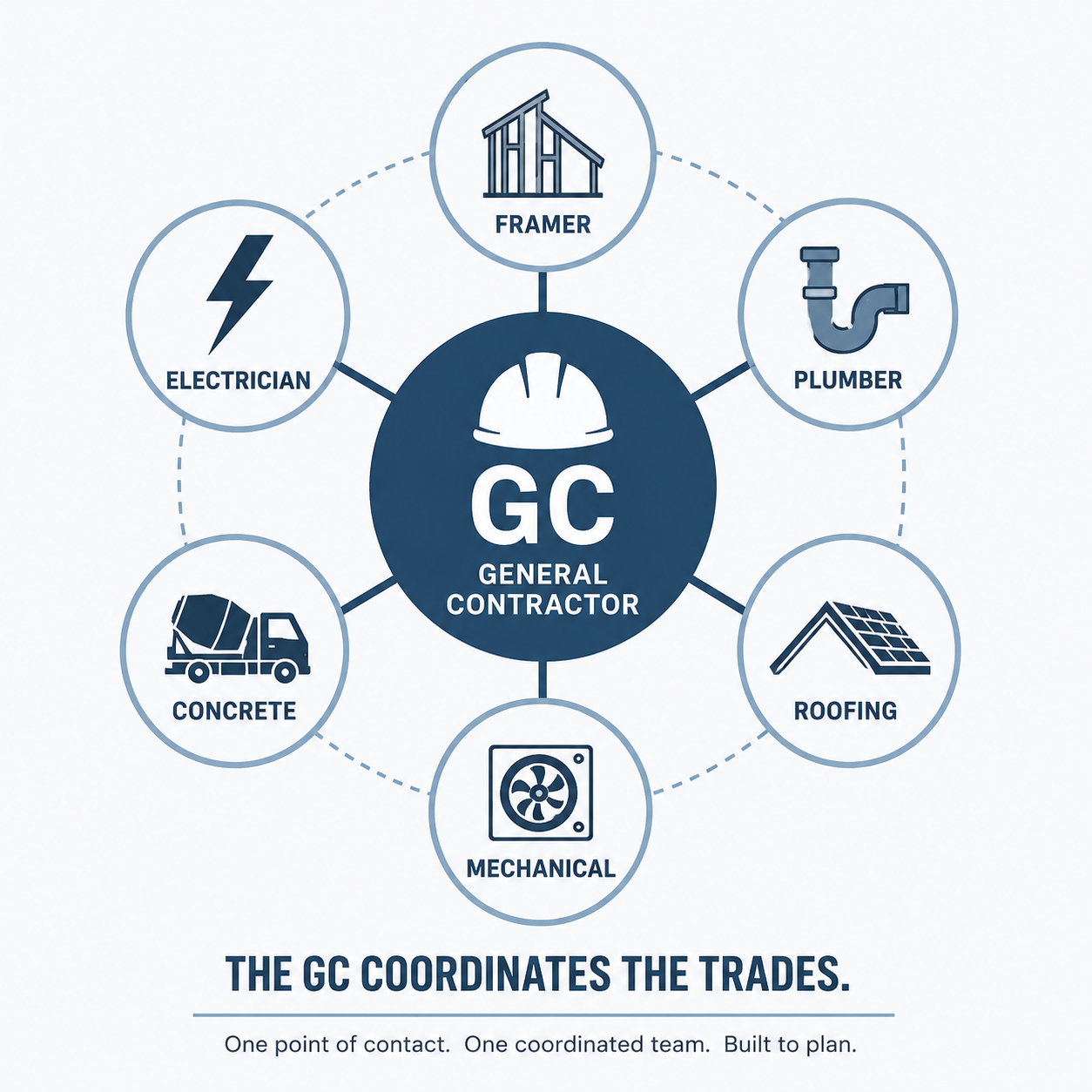
General contractors serve as the central point of coordination for construction trades, managing schedules, communication, sequencing, and project execution throughout residential and commercial construction projects in Portland, Oregon.
What an Owner's Representative Does
An Owner's Representative works exclusively for the owner. Not for the contractor, not for the architect, not for the project — for you.
Where a GC coordinates the people doing the work, an Owner's Rep coordinates the strategy around the work. That includes reviewing budgets and schedules, evaluating contractor requests and change orders, coordinating consultants, monitoring quality, tracking project risks, and helping resolve disputes when they arise — all from the owner's side of the table.
On complex projects with multiple consultants, long timelines, and significant budget exposure, that independent perspective is often what keeps a project aligned with the owner's original goals rather than drifting toward what's easiest for the team executing it.
Common Owner's Representative Services
Due diligence before property purchase
Contractor proposal review
Permit and entitlement coordination
Budget and schedule monitoring
Change order review
Construction observation
Consultant coordination
Existing building and code evaluations
Owner-side project management
Project closeout assistance
Who Each Person Actually Works For
This is the distinction that matters most, and it's worth stating plainly.
A general contractor works toward project completion. Their incentives are tied to executing the defined scope efficiently, managing their subcontractors, and maintaining their margin. When something unexpected comes up — a hidden condition, a design conflict, a material substitution, or a schedule issue — the GC's solution will be shaped by what works within their contract.
An Owner's Representative works toward owner objectives. That means budget, schedule, quality expectations, and long-term outcomes — not just what the contract says. When something unexpected comes up, an Owner's Rep asks a different set of questions:
What does this mean for the owner?
What are the available options?
What are the risks of each path?
How does this affect budget and schedule?
Is there a better alternative worth considering?
Same project. Very different frame.
A contractor's decisions are filtered through their contract. An Owner's Representative's decisions are filtered through your goals. On a complex project, that difference can be worth more than any single line item.
Where the Roles Can Create Conflict
Most contractors are honest. Most change orders are legitimate. And yet, one of the most common points of friction on any residential project is the moment a significant change order lands on the owner's desk.
The contractor says:
"We need a $25,000 change order for unforeseen conditions."
The architect reviews it and says:
"Looks legitimate to me."
The owner thinks:
"Is it? Is there another way to handle this? What am I actually agreeing to?"
Neither the contractor nor the architect is necessarily wrong in that scenario. But neither of them is solely focused on protecting the owner's position either. The architect has an ongoing relationship with the contractor. The contractor has a project to finish.
An Owner's Representative steps into that gap — not to fight, but to independently evaluate. To ask whether the scope is accurate, whether the pricing is reasonable, and whether there are alternatives worth considering before signing.
That kind of independent review, applied consistently throughout a project, is often where Owner's Representation delivers its clearest return.
Consider a $1.5 million custom home. A single 2% pricing error, overlooked allowance, or poorly evaluated change order can represent $30,000 or more in additional cost. Independent review doesn't guarantee savings, but it can help owners make informed decisions before committing to significant expenditures.
JR-DBA Owner's Representation
JR-DBA provides independent owner-side oversight for Portland-area residential and commercial projects, including:
Due diligence and feasibility reviews
Contractor proposal evaluation
Change order review
Schedule monitoring
Consultant coordination
Construction observation
Existing building and code assessments
Permit and entitlement support
When a General Contractor Is Enough
Owner's representation isn't necessary on every project — and saying otherwise would be misleading.
For a straightforward bathroom remodel, a kitchen renovation with a clear scope, or a simple deck replacement, a capable contractor and an engaged owner are often entirely sufficient. The decisions are manageable, the budget exposure is limited, and the project team is small enough that communication stays direct.
The value of independent oversight scales with complexity. On simpler projects, it may add more process than the project warrants.
When an Owner's Representative Makes Sense
The calculus shifts when projects become more complex — more consultants, longer timelines, higher budgets, or owners who are navigating the construction process for the first time.
Custom Homes
Custom homes involve dozens of decisions across architecture, engineering, interiors, landscape, and permitting. Multiple consultants need coordination. Budget and schedule drift can accumulate quietly. An Owner's Rep helps maintain clarity across the entire team from design through occupancy.
Major Remodels
Major remodels often begin with unknown existing conditions. Scope changes, phasing challenges, and sequencing conflicts are common. Independent oversight helps owners evaluate options as they arise rather than reacting under pressure.
ADUs and Residential Conversions
ADUs carry their own complexity — zoning requirements, utility coordination, System Development Charges (SDCs), permitting requirements, and tight budgets where cost overruns can have an outsized impact.
Many homeowners purchase pre-designed ADU plans online assuming they are permit-ready. In reality, most still require site-specific zoning review, structural coordination, energy code compliance, utility planning, and permit documentation before approval. Owner's Representation can help bridge the gap between a stock plan and a successfully permitted project.
Multi-Million-Dollar Residential Projects
When project budgets reach seven figures, the financial exposure alone often justifies independent oversight. Even small mistakes can have significant consequences.
Owners New to Construction
The construction process has its own language, norms, contracts, and leverage points. An Owner's Representative helps translate all of it and can help owners avoid some of the most common and costly mistakes before they happen.
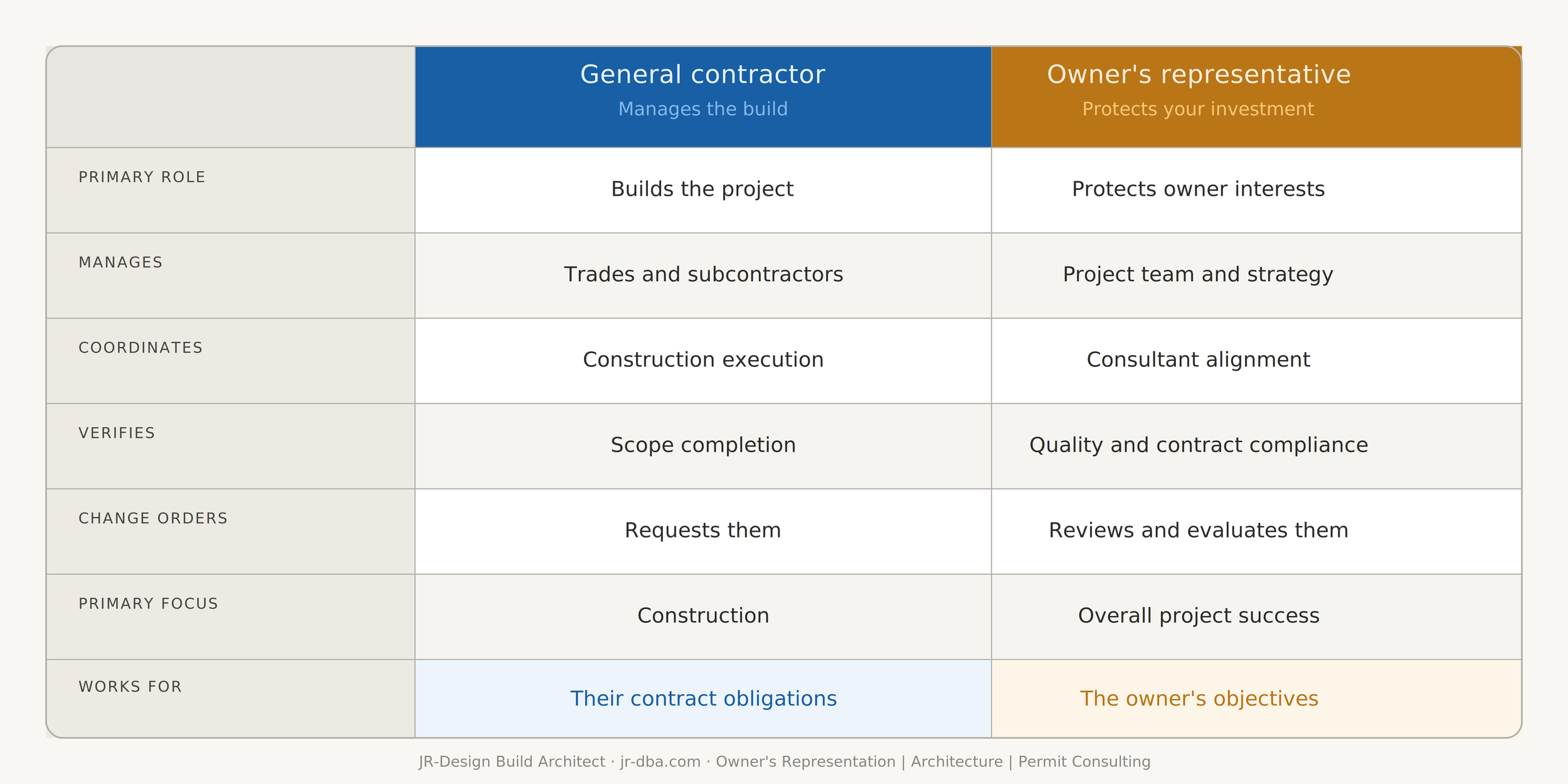
A general contractor manages the build. An owner's representative manages the outcome — on your behalf.
Two Complementary Roles
A general contractor and an Owner's Representative are not competing roles — and a good contractor will often tell you the same thing.
The contractor builds the project.
The Owner's Representative helps ensure the project being built remains aligned with your goals, your budget, your schedule, and your expectations throughout the process.
For simple projects, a contractor may be everything you need.
For complex projects — where decisions are harder, budgets are larger, and the consequences of getting it wrong are more significant — an experienced Owner's Representative provides independent oversight that helps protect one of the largest investments most people will ever make.
Planning a Custom Home, Major Remodel, or ADU?
Before committing to a contractor, signing a construction agreement, or purchasing a property, an independent project review can help identify risks, budget concerns, permitting challenges, and coordination issues that are often easier and less expensive to address early than after construction begins.
Schedule a Project Consultation →
Joshua Richards, Principal, JR-Design Build Architect Portland, Oregon — Owner's Representation | Architecture | Permit Consulting jr-dba.com | Joshua@jr-dba.com
Have a project that's showing early warning signs? Schedule a project review →
More from JR-DBA Insights
